|
THE DHARMA FLOWER SUTRA (Lotus Sutra) SEEN THROUGH THE ORAL TRANSMISSION OF NICHIREN DAISHŌNIN Essays on the Buddha Teaching
The Life of Shākyamuni
Tathāgata The Triple Entity of the Buddha (sanjin, Trikāya) The Individual Vehicle (shōjō, hīnayāna) The Universal Vehicle (daijō, mahāyāna) The Teachings derived from the external events of the Buddha Shākyamuni’s life and work (shakumon) The Teaching of the Original Archetypal State (honmon) The Five Periods and the Four Ways of Teaching The Reaches of the Mind (jinzū, abhijña)
The Life of Nichiren
The Life of Nikkō Shōnin Tendai (T’ien T’ai) The Meaning of the Title: (Sutra on the White Lotus Flower-like Mechanism of the Utterness of the Dharma) The Ideograms of Nam Myōhō Renge Kyō The Translation of Myō The Sanskrit letters on the Fundamental Object of Veneration The Four Universal Deva Sovereigns (ten’ ō, deva-rāja) Buddha versus Daishōnin Nam versus Namu When Nam Myōhō Renge Kyō was first recited Gongyō Mandalas Opening up our Inherent Buddha Nature with our Respective Personalities just as they are (soku shin jōbutsu) Troublesome worries are not separate from and can lead to enlightenment (bonnō soku bodai) The cycles of living and dying are not separate from and can lead to nirvana (shōji soku nehan) The One Instant of Thought Containing 3,000 Existential Spaces (ichinen sanzen) The theory of the fixed principle of the true nature of existence (fuhen shinnyo no ri) The wisdom with regard to the true nature of existence that changes according to karmic circumstances (zuien shinnyo no chi) Plants, trees and the inanimate objects in our respective environments making their inherent Buddha nature manifest The Buddha Teaching as a Protection and the Tatsunokuchi Incident Priest or monk?
Terms and concepts common to all Buddhist teachings
The West and the East
Mount Sumeru Preposterous Numbers Dharma versus dharma Dharma realm versus realms of dharmas Meritorious Virtues (kudoku, guna) The Guardian Deities and the Spirits of Good (shoten zenjin) The Three Obstacles and Four Negative Forces (sansho shima) Non-humans with human intelligence Existence from the Buddhist perspective Suchness (shinnyo, tathatā) Dependent Origination (Engi, pratītya-samutpāda) Relativity (kū, shūnyatā) The Nine Levels of Consciousness (kushiki) Karma (gō) Death Nirvana Faith
Shākyamuni was the historical Buddha and the founder of the Buddha teaching. As the Buddha, he was endowed with the titles of the enlightened – 1) Nyorai (Tathāgata), One who has arrived at a perfect understanding of the suchness of existence; 2) Ōgu (Arhat), Worthy of offerings; 3) Shōhenchi (Samyak Sambuddha), Correctly and universally enlightened; 4) Myōgyō-soku (Vidyā-charana-samppanna), Whose knowledge and conduct are perfect; 5) Zensei (Sugata), Who is completely free from the cycles of living and dying; 6) Sekenge (Lokavit), Understanding of the realms of existence; 7) Mujōji (Anuttara), Supreme Lord; 8) Jyōgo-jōbu (Purusha-damaya-sārathi), The Master who brings the passions and delusions of sentient beings into harmonious control; 9) Tenninshi (Shasta-deva-manushyanam), The Teacher of humankind and the deva (ten); 10) Seson (Bhagavat), and the Buddha who is the World Honoured One. Shaka (Shakya) is the name of Shākyamuni’s family and the word “muni” roughly means a sage. Shākyamuni’s birth date is not precisely known, but it seems to have been somewhere between 565 and 563 BCE. His father was king (rāja) of the Shaka (Shakya) clan whose capital was in Kapilavastu in Central India. In the same way as his father, Shākyamuni was a member of the Kshatrya caste of rulers and warriors [although he later rejected the caste system]. According to the traditional accounts of Shākyamuni’s birth, Queen Mahāmaya, at the time when she was heavily pregnant, was returning to her father’s home in order to give birth there. Having arrived at Lumbinī Park, she gave birth to Shākyamuni. It is said that when he was born, Shākyamuni stepped seven paces in all four directions. With each direction he said, “I am alone, honoured, among humankind and the deva (ten). In the threefold realm of existence where sentient beings have appetites and desires, who are incarnated in a subjective materiality with physical surroundings, and, at the same time, are endowed with the immateriality of the dimensions of fantasies, dreams, thoughts and ideas (sangai, triloka), I will save them from their sufferings.” His mother died as a result of the birth, and, several days after, the baby was put into the care of an aunt, Makahajahadai (Mahāprajāpatî). Shākyamuni was given the traditional education of a crown prince. Undoubtedly he was trained in the ways of a royal court, the religious and secular literature of his time, as well as in the various military arts. As Shākyamuni grew older, he tended to become more and more introspective. Thus his father became concerned as to whether he could succeed to the throne. The king decided that it would be better if his son were to marry. As a result, his father arranged his marriage to Yashudara (Yashodharā) at a time when Shākyamuni was about nineteen years old. Nevertheless did not affect Shākyamuni as to his destiny. His meditative introspection engrossed him all the more. He became extremely preoccupied with the problems of living and dying. Then finally, he decided to lead the life of a Brahmanical ascetic. Shākyamuni did, however, father one son, Ragora (Rāhula), who later in the same way as his wife and aunt became the Buddha’s disciple. As tradition would have it, when Shākyamuni was around twenty-nine, during the night he mounted his white horse, accompanied by only a single retainer. Rejecting the mundane world, he then set upon his course to become a sannyasi. The following day he had reached the shore of the Anuma River where he shaved his head as a gesture of leaving the laity, so as to become an ascetic. There he dismissed his retainer and went on alone. At first he visited various renowned masters of the Dharma but found that their teachings were incomplete. From then on, Shākyamuni followed the path of asceticism for six years. The folkloric tradition says that Shākyamuni’s father King Jōbon (Suddhadana) sent five men to protect and accompany his son in his practice. The folkloric tradition also states that Shākyamuni continued to practise until his body was like a skeleton and his eyes had sunk deep into his head. However, he realised that by castigating his body he would never expand his mind in order to fully understand the meaning and workings of existence. There and then he rejected the austere ascetic practices. He made his way to a riverbank where he cleansed his body. [Indian tradition has it that ascetics cover their bodies with ashes.] A girl from a neighbouring village gave him a bowl of milk curds and gradually he regained his strength. Shākyamuni then made his way beyond the forest where he had done his austere practices to a place which is now known as Buddhagāya and sat down under a pippala (pipal) tree, later known as the bodhi tree. The story has it that while Shākyamuni was meditating, many demons presented themselves in desirable manifestations and tried to tempt him and divert him from his aim to fully understand and realise the significance of existence. But Shākyamuni was able to unmask and overcome all terrestrial, negative qualities. When Shākyamuni was around thirty years old, he became fully enlightened. On his attainment to enlightenment and becoming the Buddha, he faced another inner struggle, as to whether to keep his realisation to himself or to try to explain it to ordinary people so as to enlighten them as well. On account of his compassion for all sentient beings, he decided on the latter course and made his way across India until he arrived at Deer Park, which is now called Sārnāth, near Benares (Varanasi). There Shākyamuni assembled the five men who had accompanied him during his asceticism, but had abandoned him, when he rejected the austere practices of mortifying the body so as to release the mind. On gathering these five persons together, he preached his first sermon, which in essence consisted of the Four Noble Truths: 1) all existence is suffering; 2) the cause of suffering is illusion; 3) nirvana is the dimension free from suffering; 4) the means for attainment of nirvana is the practice of the Eightfold Noble Path (Hasshōdō). The Eightfold Noble Path is so called, because it leads to nirvana. This Eightfold Noble Path consists of 1) correct view (shōken), which refers to a correct understanding of the Four Noble Truths; 2) correct thinking (shōshiyui), which is the ability to reflect on the Four Noble Truths correctly; 3) correct speech (shōgo), which implies no false statements; 4) correct action (shōgō); 5) correct livelihood (shōmyō); 6) correct endeavour to attain enlightenment (shōshōjin); 7) correct memory (shōnen), which means memory of things beneficial to enlightenment; 8) correct meditation (shōjō). Afterwards, Shākyamuni journeyed to Magadha in Central India where he was received with reverence by King Bimbashara (Bimbisarā), who became a convert to the Buddha teaching. He stayed at the Bamboo Grove Monastery (Chikurin shoja, Venuvana) where he taught the three Kashō (Kāshyapa) brothers and added Sharihotsu (Shāriputra), Mokuren (Maudgalyāna) and Makakashō (Makākashyapa) to his following. At that time the Buddha teaching acquired many more disciples as each day went by. His renown became so great that it arrived at his father’s court. Thereupon, his father sent a message asking him to return to his homeland. This he did and taught the Dharma to his father and other members of his family as well. He converted his cousin Anan (Ānanda), his half-brother Nanda (Nanda), Ragora (Rahula) his son and Daibadatta (Devadatta) who was another cousin. Makahajahadai (Mahaprajapati) who had brought up Shākyamuni also became a nun. Later after some time, Yashudara (Yashodhara) to whom he had been married also became a member of the female order. Shākyamuni taught in various places, and, even though these teachings were not recorded at the time, they became the foundation for the written scripture. He established the Buddhist community of monks, nuns, lay followers both male and female, all governed by a framework of precepts and rules. All distinctions of caste were clearly set aside. At a later period of his teaching, the Buddha encountered some opposition particularly from Daibadatta (Devadatta) his cousin, who tried to disrupt the community of monks and nuns (sangha). It is said that he also tried to kill Shākyamuni. The Buddha’s lifetime of active teaching lasted somewhere between forty-five and fifty-one years. Shākyamuni, conscious of his approaching demise, asked that his bed be placed in a clearing in the Shara (Shāla) grove near Kushinagara (Kushinagara). Realising that his extinction into nirvana was close, he expounded his final teaching, which is known as the Sutra on the Buddha’s Passing Over to the Extinction of Nirvana (Nehan kyō, Nirvana Sutra). Then, with his head pointing towards the north, with his face looking west and lying on his right side, he passed into the extinction of nirvana. When Shākyamuni died he was said to have been around eighty-one years old. According to tradition, his body was cremated. Ambassadors from eight important countries of the time arrived to claim his relics. His ashes were divided into eight portions in all and were placed in eight stupas, erected on ground sacred to the Buddha teaching in various places throughout India.
Tathāgata (Nyorai) is one of the ten titles of the Buddha. This implies that he comes from the dimension of the truth or suchness, which may be understood as the absolute reality which transcends all the phenomena and noumena that fill up our daily lives. This concept is equated with the Dharma entity (hosshin, Dharma-kāya) and cannot be expressed in words or even thought out by unenlightened people such as us. For those of us who follow the teachings of Nichiren, suchness can be none other than Nam Myōhō Renge Kyō, which means to devote our lives to and found them on the Utterness of the Dharma (Myōhō) [entirety of existence, enlightenment and unenlightenment] permeated by the underlying white lotus flower-like mechanism of the interdependence of cause, concomitancy and effect (Renge) in its whereabouts of the ten [psychological] realms of dharmas [which is every possible psychological wavelength] (Kyō). This is suchness as it has often been defined as that which cannot be pondered over or even explained (fushigi). There are two ways of translating the word Tathāgata. One is Tathā āgata, which means “he who has come from that” (suchness). This is the Sino-Japanese understanding of this Sanskrit word. In the second way, it is interpreted as Tathā gata which means “he who has arrived at that” (suchness).
The Triple Entity of the Buddha (sanjin, Trikaya) This concept is also known as the three enlightened properties. These represent the three types of entity that the Buddha possesses. On the whole, this is a concept appropriated by the various schools of the universal vehicle (daijō, mahāyāna), in order to indicate the various aspects of the Buddha as referred to in the sutras. The first is the Dharma entity (hosshin, Dharma-kāya), which is the highest aspect of this triple entity. It is the absolute nature of the mind of the Buddha. Perhaps we may understand this idea of the Buddha nature in everything, as clearly propounded in the theory of the one instant of thought containing three thousand existential spaces (ichinen sanzen). This aspect of the Buddha is ineffable, unmanifested, and not apparent in our everyday lives. The second entity is the reward body, or the entity of wisdom of the Buddha (hōshin, sambhoga-kāya). In the teaching of Nichiren Daishōnin, this entity of enlightenment can be seen as all the implications of the Fundamental Object of Veneration (gohonzon). The third entity of the Buddha is his manifestation throughout the entirety of existence (ōjin, nirmāna-kāya), which he uses as a device to ameliorate or redeem all sentient beings. This also includes the appearance of the Buddha as a person, which he uses to save humanity from itself. According to the teachings of Tendai (T’ien T’ai), he differentiates two kinds of manifested entities of the Buddha. These are 1) the inferior manifested entity, which the Buddha uses to make his appearance for the benefit of ordinary mortals, people of the two vehicles [i.e., the people who exerted themselves to attain the highest stage of the teachings of the individual vehicle (shōjō, hīnayāna) through listening to the Buddha or the intellectuals of this present age, as well as those people who have become partially enlightened due to a profound search for the meaning of existence (engaku, hyakushibutsu, pratyekabuddha)], as well as bodhisattvas who have not yet attained the first stage of development out of the fifty-two stages towards enlightenment in the doctrine of Shākyamuni. 2) There is a superior manifestation, which the Buddha uses in order to reveal himself to bodhisattvas who have gone beyond the first stage of development out of the fifty-two. The interpretations of the triple entity differ from one school to another. Throughout most of the doctrine of Shākyamuni, it was assumed that this triple entity could exist as three separate entities. However, in the Tantra and Mantra School, it is maintained that Dai-nichi Nyorai of the Tathāgata of Universal Sunlight is the highest aspect of the triple entity (hosshin, Dharma-kāya), the Buddha Amida (Amitābha) is the body of wisdom (hōshin, sambhoga-kāya), and Shākyamuni is their manifest embodiment. In accordance with the Dharma Flower Sutra (Hokke-kyō) and the theory of the one instant of thought containing three thousand existential spaces (ichinen sanzen), Tendai (T’ien T’ai) expresses the view that this triple entity does not consist of the three existences that are apart from each other, but three entities of the one Buddha. In this way, the triple entity of the Buddha is 1) the universal element of the Dharma, which has always existed and will continue to exist into eternity. This is the essential component of the Buddha’s life and the truth to which he is enlightened (hosshin, Dharma-kāya). 2) The entity of wisdom of the Buddha is all that his enlightenment entails, and again it is all that is involved in the Fundamental Object of Veneration (gohonzon) of the Nichiren Schools. 3) The physical embodiment of the Buddha (ōjin, nirmāna-kāya) is the means whereby the Buddha is able to manifest himself, in order to ferry all sentient beings from the shores of unenlightenment to the shore of Buddhahood. In the Kōmon School, Nichiren is held as the fundamental Buddha of the ever-present infinite in time (kuon ganjo) and is defined as the Buddha eternally endowed with the triple entity, that is not produced by any conditions and is free from all karma (musa no sanjin).
The Individual Vehicle (shōjō, hīnayāna) The individual vehicle (shōjō, hīnayāna), which is also known as hīnayāna (shōjō) or the Theravada School, is one of the major tendencies of the Buddhist teaching. The other major tendency is the universal vehicle, also called mahāyāna (daijō) or the Major Vehicle. The object of the teachings of the individual vehicle (shōjō, hīnayāna) is to attain the realisation of an Arhat. [In the Buddha teachings that are conveyed in Classical Chinese, this term is defined as ōgu, which means “worthy of offerings”. This expression has the undertone of a person who is free from all craving and attachments and will not be reborn. An Arhat has already freed him or herself from all mental defilements – has attained perfect knowledge, so that according to the values of ancient India there was nothing more to be learned. Such people were worthy of offerings and respect. With the rise of the concepts of the universal vehicle (daijō, mahāyāna), the individual vehicle (shōjō, hīnayāna) was used as a disparaging term by those who were already practising the universal vehicle (daijō, mahāyāna). These new practitioners censured those people who were still involved with the individual vehicle (shōjō, hīnayāna), who on the whole only practised for themselves with little or no concern for the salvation of other people. After the death of Shākyamuni, the religious order underwent various schisms, which split into various schools much in the same way as in medieval China, Japan and Korea. At the time of Shākyamuni’s demise into the extinction of nirvana, the monks of various factions in their concern for preserving the teachings of the Buddha shut themselves in their monasteries and dedicated themselves to the maintenance of various monastic precepts and doctrinal explanations of the various sutras. Also, during the same period the clerical community (sō, sangha) lost sight of the purpose of the Buddha teaching, which was to liberate all sentient beings from their sufferings and difficulties. Towards the first century BCE, or at the beginning of the first century CE, a new group of practitioners of the Buddha teaching appeared, who were no longer satisfied with what they perceived as a Brahmanic style of pedantry. The new practitioners, calling themselves bodhisattvas whose aim was to save all sentient beings, practised among ordinary people and called their doctrine the universal vehicle (daijō, mahāyāna), so as to indicate that their teaching had the capacity to lead most people to enlightenment. The more traditional schools were given the name, “the individual vehicle”. According to the teachings of Tendai (T’ien T’ai), the doctrine of the individual vehicle (shōjō, hīnayāna) consisted essentially of the twelve years of the Agon (Āgama) system of belief. These doctrines are the Four Noble Truths which are 1) the reality of all existence involves suffering in one way or another; 2) suffering is brought about by selfish desires; 3) the elimination of selfish desires is to make an endeavor to attain nirvana and 4) there exists a way through which one can eliminate one’s selfish wants by following the Eightfold Path. The Eightfold Path entails 1) correct views in regard to the Four Noble Truths and the freedom from ordinary thinking, 2) correct thought and purpose, 3) correct speech and the avoidance of false and idle talk, 4) correct conduct and getting rid of all improper thoughts and deeds so as to be able to live in purity, 5) earning one’s living correctly which entails neither harming nor killing other sentient beings, 6) correct energy in an uninterrupted progress in search of enlightenment, 7) a correct memory which retains the truth and excludes the false and 8) correct meditation or absorption into the object of meditation. The Agon (Āgama) teachings included the Chain of the Twelve Causes and Concomitancies that run through all sentient existence. They are 1) a fundamental unenlightenment of not wanting to know what existence is all about; 2) natural tendencies and inclinations that are inherited from former lives; 3) the first consciousness after conception that takes place in the womb; 4) body and mind evolving in the womb; 5) the development of the five organs of sense and the functioning of the mind; 6) birth and contact with the outside world; 7) receptivity or budding intelligence and discrimination from six to seven years onwards; 8) yearnings and desires for amorous love at the age of puberty; 9) the urge for a sensuous existence that forms 10) the substance for future karma; 11) the completed karma ready to be born again and 12) facing the direction of old age and death. What was not included in the teachings of the individual vehicle (shōjō, hīnayāna) was the idea of devoting our lives to and founding them on (Nam) the Utterness of the Dharma (Myōhō) [entirety of existence, enlightenment and unenlightenment] permeated by the white lotus flower-like mechanism of the interdependence of cause, concomitancy and effect (Renge) in its psychological whereabouts of the ten [psychological] realms of dharmas [which is every possible psychological wavelength] (Kyō), which is Nam Myōhō Renge Kyō and the all-embracing equation that pervades all existence.
The Universal Vehicle (daijō, mahāyāna) The teachings of the universal vehicle (daijō, mahāyāna) consist of the bodhisattva practice as a means of attaining enlightenment not only for oneself but also for others. These teachings stand in contrast to those of the individual vehicle (shōjō, hīnayāna) whose objective was to attain a certain enlightenment for oneself only. After the demise of Shākyamuni into the extinction of nirvana, the Buddha teaching split into a number of different schools, each one developing its own interpretation of the sutras and other teachings. As time went by, these religious communities tended to isolate themselves from the laity, shutting themselves up into their various monasteries where they dedicated themselves to writing explanatory theses on the sutras, as well as following the monastic precepts to the letter. These religious communities gradually lost all sight of the original Buddha teaching which was to lead all sentient beings to enlightenment. Between the end of the first century BCE and the first century of the Common Era, there appeared a new group of believers of the Buddha teaching who expressed their disagreement with the elitism of the traditional monastic orders. The object of this new group was to save all sentient beings and they called their teaching the universal vehicle (daijō, mahāyāna). This means that their teaching is all-embracing (dai, mahā) and they denounced the more traditional schools of the individual vehicle (shōjō, hīnayāna). According to some schools and indologists, the universal vehicle (daijō, mahāyāna) had its origins in the popular practice of venerating stupas which spread throughout India during the reign of King Ashoka (268 – 232 BCE). In any case, this movement seems to have come about as an attempt to restore the original intention of the Buddha teaching, in which both the religious orders and the laity could take part. According to the teaching of Tendai (T’ien T’ai), Shākyamuni’s doctrinal periods of the Flower Garland Sutra (Kegon, Avatāmsaka), the equally broad teachings (hōdō, vaipulya), the wisdom (hannya, prajña) period, and the Dharma Flower and Nirvana Sutra periods are in essence the universal vehicle (daijō, mahāyāna). Whereas the individual vehicle (shōjō, hīnayāna) indoctrinated its followers to get rid of their worldly and bodily inclinations, the universal vehicle (daijō, mahāyāna) considered such tendencies from a more positive viewpoint and proposed to help people find their bearings. Again, such a viewpoint culminated in the Dharma Flower Sutra (Hokke-kyō), which teaches that our troublesome worries (bonnō, klesha) are not separate from our enlightenment. The Chinese monk E’on (Hui Yuan 523 – 592 CE) said that there exist two kinds of universal vehicle (daijō, mahāyāna), one being the perfect universal vehicle (daijō, mahāyāna) and the other being the provisional one. The provisional universal vehicle doctrine covers teachings that were expounded for the time being, so as to instruct people as well as raising their level of understanding. The teachings of the perfect universal vehicle (daijō, mahāyāna) are those that are based on the straightforward assertion that the enlightenment of Shākyamuni is as indestructible and eternal as life itself. This concept is clearly expressed in the Sixteenth Chapter on the Lifespan of the Tathāgata in the Dharma Flower Sutra (Hokke-kyō). Tendai (T’ie T’ai) states that the provisional universal vehicle consists of the doctrinal periods of the Flower Garland Sutra (Kegon, Avatāmsaka), the equally broad teachings (hōdō, vaipulya), and the wisdom (hannya, prajña) period, whereas the perfect universal vehicle (daijō, mahāyāna) only comprises the teachings of the original archetypal state (honmon) of the Dharma Flower Sutra (Hokke-kyō) and to a lesser extent the Nirvana Sutra.
The Teachings derived from the external events of the Buddha Shākyamuni’s life and work (shakumon) These teachings refer to the first fourteen of the twenty-eight chapters of the Dharma Flower Sutra, that is to say, from the First and Introductory Chapter to the Fourteenth Chapter on Practising with Peace and Joy. The Universal Teacher Tendai (T’ien T’ai) divided the Dharma Flower Sutra (Hokke-kyō) into two separate parts. The first fourteen chapters refer to the external events of the Buddha Shākyamuni’s life and work (shakumon) for which some schools use the term “the theoretical teachings”. The following fourteen chapters are referred to as the “teachings of the original archetypal state” or as some schools call it “the essential teachings” (honmon). The teachings derived from the external events of the Buddha Shākyamuni’s life and work are, as this expression implies, the teachings expounded by the Buddha Shākyamuni who is described as having attained enlightenment in Buddhagāya under the bodhi tree when he was about thirty years old, whereas the teachings of the original archetypal state refer to the time when the Buddha Shākyamuni realised the indestructibility and eternity of life, not only that of himself but also that of us who are ordinary people. At that time the eternal and indestructible quality of life was expressed as a concept in the depths of our minds as the uncountable grains of dust that would be left should someone grind five hundred universes from their inception to their termination into powder. This concept is perpetuity itself, which we experience in our daily lives as the ever-present infinite in time (kuon ganjo). In this way the Buddha Shākyamuni puts his present incarnation to one side so as to reveal the eternity of his and our own lives. The Universal Teacher Tendai (T’ien T’ai) compares the relationship between the eternal Buddha and his incarnation as Shākyamuni to the moon in the sky and its reflection in pools of water. The essence of the teachings derived from the external events of the Buddha Shākyamuni’s life and work is the second chapter of the Dharma Flower Sutra on Expedient Means, where he expounds the real aspect of all dharmas as being every way they make themselves present to any of our six organs of sense [eyes, ears, nose, tongue, bodily touch and the mind which perceives dharmas]. This chapter also points out that the advent of all the Buddhas into this world is to lead all sentient beings towards opening their inherent store of perceptive wisdom (kai), to demonstrate and point out its meaning (shi), to cause sentient beings to apprehend and be aware of it (go), so as to lead humankind into the perceptive wisdom of the Buddha (nyū). This chapter also makes clear that the three realms of dharmas were simply three kinds of expedient means, in order to lead people onto the path of Buddhahood. These three realms of dharmas refer to 1) intellectual seekers who, at the time of Shākyamuni, were people who exerted themselves to attain the highest stage of the teachings of the individual vehicle (shōjō, hīnayāna) [i.e., to become arhats (arakan)] through listening to the Buddha (shōmon, shrāvaka), 2) people who were partially enlightened, due to a profound search for the meaning of existence (engaku, hyakushibutsu, pratyekabuddha), and 3) the altruists or bodhisattvas, whose object was to become enlightened and to enlighten other people.
The Teaching of the Original Archetypal State (honmon) This is the teaching expounded by Shākyamuni when he reveals his real identity of being life itself. This teaching is comprised of the latter fourteen chapters of the Dharma Flower Sutra (Hokke-kyō), from the Fifteenth Chapter on the Bodhisattvas who swarm up out of the Earth to the Twenty-eighth Chapter on the Persuasiveness of the Bodhisattva Universally Worthy (Fugen, Samantabhadra) [Fugen Bosatsu Kanpatsu Bon]. As was stated above, the Universal Teacher Tendai (T’ien T’ai) in his Textual Explanation of the Dharma Flower Sutra (Hokke Mongu) divides the Dharma Flower Sutra (Hokke-kyō) into two parts. The first fourteen chapters consist of the teachings derived from the external events of the Buddha Shākyamuni’s life and work (shakumon) and the following fourteen chapters comprise the teaching of the original archetypal state (honmon) which is a dimension that can only be reached by deep contemplation, only to discover that it lies at the very foundation of our lives and implies life itself. The difference between the teachings derived from the external events of the Buddha Shākyamuni’s life and work and those of the original archetypal state is that the first fourteen chapters indicate that the possibility of enlightenment is inherent in all human beings, whereas the essence of the original archetypal state is in the Sixteenth Chapter on the Lifespan of the Tathāgata where Shākyamuni tells the assembly that he attained enlightenment in an infinite past and that his enlightenment will perpetuate into an eternal future. Since Buddhahood is not separate from the other nine realms of dharmas [a realm of dharmas is a space where dharmas occur i.e., 1) the various hells, 2) hungry spirits, 3) animality, 4) titans or giants (shurakai), 5) human equanimity, 6) provisional ecstasies, 7) intellectual seekers, 8) people who are partially enlightened and 9) bodhisattvas], this would imply that the dimension of Buddhahood is the wisdom of understanding all the connotations that involve Nam Myōhō Renge Kyō, which is what life is itself. It is in the Chapter on the Lifespan of the Tathāgata where Shākyamuni makes the three principles of Utterness (Myō) conspicuously clear. These are 1) the Utterness of the original fruition (hongamyō) which is the enlightenment of the Buddha that infers the original mind as being absolutely pure and intelligent and also regarded as the embodiment of the Dharma [i.e., existence (hosshin, Dharma-kāya)], 2) the Utterness of the original cause (honinmyō) which implies the practices observed in order to attain Buddhahood and 3) the Utterness of the original terrain (honkokudo) which is where the Buddha lives and teaches. These three principles of Utterness make the enlightenment of the Buddha clear as to where, when and how it happened. Occasionally, Nichiren uses the expression “the teaching of the original archetypal state” to specify his concept of the Buddha doctrine. This can be compared to Nam Myōhō Renge Kyō which means to devote our lives to and found them on (Nam) the Utterness of the Dharma [entirety of existence, enlightenment and unenlightenment] (Myōhō) permeated by the underlying white lotus flower-like mechanism of the interdependence of cause, concomitancy and effect (Renge) in its whereabouts of the ten [psychological] realms of dharmas [which is every possible psychological wavelength] (Kyō) and summarises all that life is in a nutshell. The three esoteric Dharmas (sandai hihō) – 1) the Fundamental Object of Veneration (gohonzon) of the teaching of the original archetypal state (honmon no honzon), the recitation of the theme and title of the teaching of the original archetypal state (honmon no daimoku) and 3) the altar of the precept of the teaching of the original archetypal state (honmon no kaidan) – are all considered to be provisional teachings but Nam Myōhō Renge Kyō is the fundamental teaching of the original archetypal state.
The Five Periods and the Four Ways of Teaching The five periods and the four ways of teaching are a comparative classification of the Buddha teachings of Shākyamuni which was established by Tendai (T’ien T’ai) in The Recondite Meaning of the Dharma Flower Sutra (Hokke Gengi Shakusen), in order to show the superiority of the Dharma Flower Sutra (Hokke-kyō) as opposed to all the other sutras and teachings of Shākyamuni. This classification is the alleged order in which the teachings were expounded. The Flower Garland Sutra (Kegon, Avatāmsaka) was Shākyamuni’s first exposition after his enlightenment under the bodhi tree and was expounded for the benefit of his five companions, who were practising various Brahmanical austerities alongside him. Hence this teaching is often understood as a specific doctrine for bodhisattvas. The essence of this teaching is that each and every single dharma is impregnated by all the other dharmas in existence. It is also the sutra that clearly enumerates all the stages of bodhisattva practice. The teaching of the individual vehicle (shōjō, hīnayāna) lists four in Chinese and five in Pali. These teachings are often called the Agon gyōor the āgamas which are understood as “The Traditionally Transmitted Teachings”. This nonspecific term is used to cover these earlier teachings of Shākyamuni which were no doubt riddled with various Brahmanical prejudices and concepts of purity. Here it might be wise to emphasise that all individuals are victims of their own culture including enlightened individuals such as Shākyamuni, Tendai (T’ien T’ai) and Nichiren. Hōdō (Skt. Vaipulya) may well be translated into English as “Equally Square”. It is a term applied to the third of the teaching periods of Shākyamuni and is often referred to as the provisional universal vehicle. In Soothill’s Dictionary of Chinese Buddhist Terms, it says that the equally square teachings (Hōdō, Vaipulya) are distinguished as an expansion of doctrine and style. These sutras are apparently of a later date, showing the influence of different schools. Their style is lengthy and with tedious repeating of the same idea over and over again. Probably such repetitions were for instructional purposes, since learning in medieval China was simply learning by memorisation. The fourth period of teaching was the Hannya or Wisdom doctrines. Hannya, or Prajñā in Sanskrit, means ‘to know’, ‘to understand’, or ‘wisdom’. The type of wisdom is described as the “supreme”, “highest”, “incomparable”, “unsurpassed” and “unequaled”. There are a number of sutras referred to as the Prajñāparamitas which describe the wisdom that carries people from the shores of mortality to that of nirvana. The essence of these teachings is spoken of as the principal means of attaining nirvana, through their revelation of the insubstantiality of existence (kū, shūnyatā). The final period is the Dharma Flower Sutra (Hokke-kyō) which is the fundamental canonical text of all the Nichiren and Tendai Schools. There are various versions of this sutra in Sanskrit, either from Central Asia, Nepal, or Cashmere; also there are six Chinese translations and one Tibetan. For those who are involved with the practices of the Nichiren Schools, the most important translation of this sutra is that of Kumārajîva (Kumarajū) [approx. 409 C.E.] which is also the basis for this interpretive and explanatory translation. At the time of Shākyamuni there were in Brahmanistic circles enormous prejudices against women, even though at the same time there were Tantric practices that were based on sexual rituals. Still, it is stated here in the Dharma Flower Sutra (Hokke-kyō) that women can attain enlightenment. The Dharma Flower Sutra (Hokke-kyō) also says that very misguided people and individuals whose intelligence is not outstanding are able to attain enlightenment as well. The four teachings of the doctrine and the four teachings according to their methods of instruction are 1) Zōkyō, which are teachings mainly based on those of the individual vehicle (shōjō, hīnayāna), 2) Bekkyō, the teachings based on the Flower Garland Sutra (Kegon, Avatāmsaka) which specifically for the instruction of mature bodhisattvas, 3) Tsūgyō, the intermediary teachings that act as a link between the teachings of the individual vehicle (shōjō, hīnayāna) and the universal vehicle (daijō, mahāyāna) and 4) Engyō, the all-inclusive teaching which is the Buddha teaching that can lead all sentient beings to perfect enlightenment. The four ways of teaching are classified as follows: 1) Tongyō, the teaching of instantaneous enlightenment as opposed to the doctrines that propound a Buddha awakening after numerous kalpas of practice, 2) Zengyō, the teaching of gradual enlightenment, the step by step attainment of Buddhahood, 3) Himitsukyō, teaching in a secret way by which one can hear the Dharma without being noticed in the assembly and 4) Fujokyō, the indefinite way of teaching by which people in the same assembly will each interpret the Dharma in a different manner, and each individual will derive benefit from it.
The Reaches of the Mind (jinzū, abhijña) When it comes to the reaches of the mind, this technical term has the undertone of how far the psyche can be extended. Obviously, the reaches of the mind “par excellence” are those of the Buddha Shākyamuni in his role of the original or fundamental enlightenment which are recounted in the Sixteenth Chapter on the Lifespan of the Tathāgata. What this chapter entails is that the Buddha is fully aware of his own eternity as well as having a very clear understanding of how existence functions. Existence has no beginning and no end. Existence always exists, even though due to karmic circumstances it changes. Life according to the Buddha teaching is an essential part of existence. Existence without life would simply be a physicality of no importance, although there have been periods when existence has been one enormous conflagration or vacuum filled with dark matter and totally unsupportable of any form of life as we know it. Could the medieval tales of salamanders, which were something like elementals that lived in fire, shed any light on this dilemma? Even though such a concept infers physicality, real existence would imply a material body that was encased in a subjective mind that could withstand fire or vacuity. However, from a Buddhist viewpoint, the essential ingredient of existence is mind. In the teaching of Nichiren, the title and theme of the Dharma Flower Sutra (daimoku) with the added “Namu” from the Sanskrit Namas, which means to devote our lives to, and according to the patriarch Nittatsu, has the implication of founding them on life itself. Nam Myōhō Renge Kyō has the meaning to devote our lives to and found then on (Nam) the Utterness of the Dharma (Myōhō) [entirety of existence, enlightenment and unenlightenment] permeated by the underlying white lotus flower-like mechanism of the interdependence of cause, concomitancy and effect (Renge) in its whereabouts of the ten [psychological] realms of dharmas [which is every possible psychological wavelength] (Kyō). Albeit our existence according to the Buddha teaching is a temporary binding of the five aggregates – which are 1) form and materiality that give us the illusion that we are in possession of a body in physical surroundings, 2) this embodiment according to its past karma has its own perceptions in the sense that we don’t all see the same colour red or that certain foods do not have the same taste from one individual to another, 3) this subjective embodiment is capable of concepts and ideas, 4) these fantasies, inner visions, concepts and ideas are conditioned by the experiences that we underwent in the spaces between dying and being reborn, 5) as we grow up and become mature individuals, our respective ways of perceiving life are also qualified by these former four aggregates – also, we have to include the ten [psychological] realms of dharmas, the ten ways in which dharmas makes themselves present to any of our six organs of sense and the three existential spaces upon which we depend for an existence. This of course is the one instant of mental activity containing all the possibilities of life (ichinen sanzen). According to this vision of life or the way we perceive our individual lives, the denizens of hell really suffer acutely as in our present-day war zones and, at the same time, the Buddhas are said to have a terrain upon which they depend for an existence, as has been referred to in so many sutras. Coming back to the point, which is the reaches of the mind, they are, as the Buddha Shākyamuni says himself, suspended in the infinity of time, with an extremely clear insight into the way the whole of existence works, with its causes, karmic circumstances with every conceivable result. Nevertheless, there is another aspect of the expression, “reaches of the mind” which refers to powers that ordinary people such as us cannot perform. Within the bounds of Buddhist folklore, the Buddha Shākyamuni is endowed with ubiquitous powers such as the means to cause the earth to shake, issue light from the pores of his skin, extend his tongue as far as the heavens of the Brahmanic deva (Bonten) [see description of Mount Sumeru], to be effluent with light, the ability to cause flowers and objects to rain from the sky along with various apocryphal powers. Other beings such as Buddha emanations, bodhisattvas, deva (ten), arhats are sometimes accredited with similar powers.
Nichiren was born on the 16th of the second month of the first year of Jō.ō (1222 CE) in the fishing village of Kominato in the Tōjō district of the Awa province – the present-day village of Kominato in the Chiba Prefecture – and died on the 13th of the tenth month in the fifth year of Kō.an (1282 CE). His father was Mikuni no Taifu; his mother was called Umegikunyo. They were said to have led a humble existence along the seashore. As a child he was called Zennichi Maro. At the age of twelve he entered Seichōji Temple under the instruction of the Venerable Dōzen who gave him the name of Yaku’ ō Maro. At about the same time, Nichiren made a vow to the Bodhisattva Kokūzō (Ākāsha-garbha bodhisattva) that he would become the wisest man in Japan. He took sage-like orders when he was sixteen and was renamed Zeshōbō Renchō. Next, he left for Kamakura for further studies and three years later came back to the Seichōji Temple only to quickly leave again for Kyōto in order to study and practise the Dharma gateways of the Tendai School on Mount Hiei. More precisely it was at the Onjōji Temple, the Tennōji Temple and on Mount Kōya where he studied the doctrinal significance of each and every school that included reading through all the sutras and various Buddhist writings. At the age of thirty-one Nichiren left Mount Hiei and returned to Seichōji Temple. On the morning of April 28th, 1253, in the Hall of Holding to the Buddha (Jibutsutō) in the All Buddhas Monastic Residence (Shobutsubō) of the Seichōji Temple, in front of the whole assembly he announced his fourfold criterion of “Those who bear in mind the formula of the Buddha Amida (Amitābha) (Nembutsu) bring about the hell of incessant suffering; the School of watchful attention (Zen) is the work of the Universal Demon of the Sixth Heaven above Mount Sumeru; the Tantric (Shingon) School entails the ruin of the state and the Ritsu School are the robbers of the land.” He also announced that all sentient beings could be saved by the recitation of Nam Myōhō Renge Kyō. When Tōjō Kagenobu, the local ruler who was a follower of Nembutsu – i.e., the people who bear in mind the formula of the Buddha Amida (Amitābha) – heard this, he flew into a rage and tried to have Nichiren arrested. However the Venerable Jōken and Gijō, acting as guides, were able to organise his escape and he made his way back to Kominato. After taking leave of his parents he embarked upon his life’s destiny of propagating his teaching. He began his mission in Nagoe no Matsubatani outside Kamakura where he had built a hermit’s cottage. At that period he converted numerous people who became his disciples and supporters. In the eleventh month of the fifth year of Kenchō (1253) he was visited by a monk from Mount Hiei called Jōben who was later to become Nisshō, one of the six elder monks. In 1258 on a visit to the Iwamoto Jissōji Temple, the then thirteen-year-old Nikkō Shōnin became his disciple and was to remain so, until he became the second patriarch after Nichiren’s demise in 1282. Among the other disciples there was Toki Jōnin who was a samurai attached to the Shogunate, as well as other samurais such as Shijō Kingo, Soya Kyōshin, Kudō Yoshitaka, and the two Ikegami brothers Munenaka and Munenaga. On the 16th day of the seventh month of the first year of Bun.ō (1260), as a result of the good offices of Yadoya Nyūdō, Nichiren was able to have his well-known Thesis on Securing the Peace of the Realm through the Establishment of the Correct Dharma handed over to the regent Hōjō Tokiyori. The argument of this thesis is that, if the correct Buddha teaching were established, instead of the incomplete doctrines of the time, then the whole country would find peace and stability. That same year on the night of the 27th of the eighth month, the followers of Nembutsu and the Shogunate organised an attack on Nichiren’s hermitage at Matsubatani. Fortunately he was able to escape harm and moved to the estate of Toki Jōnin. On the 12th day of the fifth month of the first year of Kōchō (1261), under the orders of the Shogunate, he was exiled to the Izu Peninsula. His disciple Nikkō and Funamori Yasaburō along with the latter’s wife accompanied him and were constantly in attendance. One year and nine months later Nichiren was pardoned, and he returned to Kamakura. In the first year of Bun.ei (1264) he returned to his birthplace in Awa in order to take care of his mother during her illness. During that same time he propagated his teaching throughout the whole of the Awa region. In the same year on the eleventh day of the eleventh month, while Kudō Yoshitaka of Amatsu was returning towards his own estate, his military escort was attacked by Tōjō Kagenobu, the local ruler, in Komatsubara. Both Kudō Yoshitaka and the Venerable Kyōnin were killed in the struggle. Nichiren was also wounded on the forehead. In 1268 the Mongolian court sent a delegation with a letter from Kublai Khan demanding that the Shogunate become his vassal. This particular incident was evident proof of the prediction in the Thesis on Securing the Peace of the Realm through the Establishment of the Correct Dharma which again urged the nation to take refuge in the correct Dharma. At the same time, Nichiren called for a public debate with the monks of all the other schools and sent letters to eleven various religious leaders. But he received no reply whatsoever. During the eighth year of Bun.ei (1271) there was a terrible drought from one end of the Japanese archipelago to the other. The renowned monk Ryōkan performed the prayer ritual for rain but was unable to bring it about whereas Nichiren’s success is well-established in the annals of Japanese history. The defeated Ryōkan left Kamakura for the north. This became an opportunity for the monks of the other schools to provoke the Shogunate with slanderous reports concerning Nichiren. On the tenth day of the ninth month of that same year, Nichiren received a summons from Heinosaemon no Jō Yoritsuna to be interrogated by the Court of Enquiry. At the interrogation he severely reprimanded the hypocritical stance of the Shogunate. The outraged Heinosaemon no Jō immediately had Nichiren arrested and taken in the middle of the night to Tatsu no Kuchi to face execution. However, just as the executioner’s sword was about to strike, an enormous crystalline, pure white light surged up and covered half of the sky. In panic the officials of the Shogunate and the samurai in attendance ran in all directions and hid. No one dared try to execute Nichiren. This is the moment when Nichiren reveals the original terrain of the self-received reward body that is used by the Tathāgata of the primordial infinity of the original beginning. It is also referred to as ‘eradicating the temporary gateway in order to reveal the original archetypal state’. On the tenth day of the eleventh month he was exiled to the island of Sado. There he began to compose the Thesis on Clearing the Eyes, the Thesis on the Instigator's Fundamental Object of Veneration for Contemplating the Mind and also completed a number of important theses, such as, the Thesis on the Unbroken Transmission of the Single Universal Concern of Life and Death, the Thesis on the Significance of the Actual Fundamental Substance, An Account of the Buddha's Revelations for the Future, and the Thesis on Cultivating Oneself in the Practice as it is Expounded. During this exile, several of his admirers such as the Venerable Abutsu and his wife took refuge in his teaching. At Tsukahara where he was forced to spend his exile in the broken-down Sanmaidō Temple, the Nembutsu School challenged him to an open debate in which he completely refuted each and every argument. At this point the Venerable Sairen and the Honma family were converted to the Teachings of Nichiren. After two years or so, in 1274 on the 27th day of the third month of the eleventh year of Bun.ei, Nichiren was granted a pardon, and he returned to Kamakura. On the eighth day of the fourth month of the same year he was summoned a second time by Heinosaemon no Jō to appear before the Shogunate. This time they calmly admonished Nichiren and told him to treat and view the monks from the other schools as equals. Naturally, the reply was that if the Correct Dharma was not held to then it, then it could not be possible to assure the security of the land. The outcome of this interview was that Nichiren, like other wise men of the past in China and Japan when their efforts to save their country went unheeded, retired to the backwoods to a more hermit-like existence. In this case Nichiren retired to the Hagiri district on Mount Minobu in the province of Kai which is the present-day Yamanashi prefecture. There he gave lectures on the Dharma Flower Sutra (Hokke-kyō) and for the preparation and education of his disciples he went into the subtlest details so that the dharma would be protracted into eternity. During this same period he also wrote the Thesis on Selecting the Time and the Thesis on the Requital of Grace. The Senior Monk Nikkō promoted propagation in the direction of Mount Fuji. His first major conversion was Nanjō Tokimitsu. Then, there were the Matsuno and Kawai no Yui families and others from among the monks of Ryūsenji Temple in Atsuhara. Nisshū, Nichiben and Nichizen also took refuge in the teachings of Nichiren. During the same period a number of the local peasants and farmers did the same. On the 21st day of the ninth month of the second year of Kō.an (1279), all the followers of Nichiren, both monks and laymen, were harassed and pestered as a single sect. Finally twenty people, beginning with Jinshirō, were arrested. Heinosaemon no Jō interrogated the prisoners at his private residence and pressured them to change their religion. With profound faith all of them persisted in reciting the title and theme Nam Myōhō Renge Kyō. Jinshirō, Yagorō, and Yarokurō were beheaded, and the remaining seventeen were banished from Atsuhara. These events are often referred to as the adversity of the dharma at Atsuhara. Nevertheless it was on account of this particular adversity of the dharma that Nichiren felt that the time had come for him to fulfil his real purpose of coming into the world. On the 12th day of the tenth month of the second year of Kō.an (1279) he inscribed the Fundamental Object of Veneration (gohonzon) of the Altar of the Precept of the Original Gateway. In order to perpetuate his teaching, Nichiren appointed six elder monks to help him in this task but decided to entrust the succession of the patriarchate to Nikkō. In 1282, while undertaking a journey to the hot springs in Hitachi for rest and recuperation, he entered peacefully and auspiciously into nirvana, at the age of 61 years, in the mansion of Ikegami Munenaka. Nikkō Shōnin (1246-1333), or Byakuran Ajari Nikkō, was the successor of Nichiren and the second patriarch of the Nichiren Shōshū School, as well as being the founder of their main temple Taiseki-ji. He was born in Kajikazawa in the province of Kai, which is now the Yamanachi prefecture in modern Japan. His father’s name was Oi no kitsuroku, and his mother was a member of the family Yui of Fuji. When Nikkō was still a child, his father died, and his mother married into another family. Nikkō was brought up by his grandfather. When he was seven years old, he entered the Tendai School at Shijūku-in temple, in the province of Suruga [present-day Shizuoka]. Apart from the doctrines of the Tendai School, he studied the Chinese classics, Japanese literature, poetry, calligraphy, as well as various other subjects that were studied at the time. The Shijūku-in temple was closely connected with the Jissō-ji temple, which was visited by Nichiren Daishōnin in 1258 to do research in its library, in preparation for writing, Securing the Peace of the Realm through the Establishment of the Correct Dharma (Risshō Ankoku ron). Nikkō, on this occasion, had the opportunity to assist Nichiren in his investigations and expressed the desire to become his disciple. Nikkō was only thirteen years old at the time and received the name Hoki-bō. From that moment onwards, he devotedly served Nichiren. In 1261, at the age of fifteen, he also rejoined his teacher, during his exile in Izu. He converted the monk of the Tantric and Mantra School (Shingon), Gyōman, of the Kongō-in temple. Nikkō also shared Nichiren’s exile in Sado, 1271-1273. After their return from Sado and Nichiren’s third admonition to the government, Nichiren decided there and then to leave Kamakura. Nikkō arranged with one of his converts, Lord Hakiri Sanenaga, the commissioner of the area of Mount Minobu, to establish a retreat for Nichiren. During 1278, Nikkō Shōnin took down notes from a series of lectures given by Nichiren to his foremost disciples in Minobu and compiled them into, The Oral Transmission on the Meaning of the Dharma Flower Sutra (Ongi Kuden). He also made enormous efforts to propagate the doctrine of Nichiren in the provinces of Kai [present-day Yamanashi], as well as Suruga [present-day Shizuoka], and Izu. In the province of Suruga, both monks of Shujūku-ji and Ryūsen-ji temples were converted to the teachings of Nichiren. As the number of converts grew, among whom were farmers and ordinary people, the pressure on Nichiren’s disciples increased. The first to be persecuted were the younger converted monks, who were expelled from Shijūku-in temple. At the Ryūsenji temple in Atsuhara, the principle monk, Gyōchi, threatened the monks, among whom were Nisshū, Nichiben, and Nichizen who had been converted by Nikkō, as well as harassing their lay followers. Finally Gyōchi had twenty farmers arrested, and on the 27th of December, 1279, three of them were beheaded. This incident is known as the Persecution of Atsuhara. Nichiren, feeling that his death was near at hand, appointed Nikkō Shōnin as his successor in two documents of bequeathal. One was written in September 1282, in Minobu. The other was written on the day of Nichiren’s death, 13th of October 1282, at Ikegami.
Tendai (T’ien T’ai) or Chih-yi 538 – 587 C.E. was the founder of the Tendai School. Tendai (T’ien T’ai) is usually referred to as the Universal Teacher Tendai (Tendai Daishi). His name and title are derived from the T’ien T’ai Mountain in China, where he lived during the periods of the Northern and Southern Dynasties, as well as the Sui. He was born in Hua-Jung in the province of Ching-Chou, where his father was a high-ranking functionary under the government of the Liaug Dynasty. Due to the fall of this regime, Tendai’s (T’ien T’ai) family were forced to become exiles. Shortly after Tendai (T’ien T’ai) turned eighteen, his parents died, at which time he entered the Kuo Yuan Shih temple. Afterwards, he went to Ta-Hsien, where he studied special portions of the Dharma Flower Sutra (Hokke-kyō). At the age of twenty-three, he visited his teacher, Nan Yüeh (Nangaku) on Mount Ta-su, in order to be able to study under his tutorship. After a period of intense practice, he became enlightened, while studying the twenty-third chapter of the Dharma Flower Sutra (Hokke-kyō) on the original conduct of the Bodhisattva Sovereign Medicine (Yaku’ ō, Bhaishajya-rāja). The Universal Teacher Tendai (T’ien T’ai) came to be considered the Buddha of the period when the Dharma was an imitative display of itself (zōbō). After some years of practice under the direction of Nan Yüeh (Nangaku), he left Mount Ta-su and went to Chin-Ling, which was the capital of the Chen Dynasty, and lived in the temple of Wa Kuan Shih. There he gave lectures on the Dharma Flower Sutra (Hokke-kyō) and other relevant texts, over the next eight years. His reputation grew and attracted numerous disciples. However, regretting the fact that people with some degree of wisdom were on the decrease, he retired to Mont T’ien T’ai in 575 C.E. This phase of his life was followed by the emperor’s request to give lectures on the hundred fascicle commentary of the Sutra that Ferries People over the Seas of Mortality to the Shore of Nirvana (Daichido-ron) of Nāgārjuna (Ryūjū), along with the sutra about a benevolent king who protects his country, by means of the Buddha teaching (Ninnō Gyō). Tendai (T’ien T’ai) also made discourses at the Temple Kuang Tse Shih, which were ultimately compiled into the Textual Explanation of the Dharma Flower Sutra (Hokke Mongu). After the fall of the Chen Dynasty, he returned to his native town, where he expounded the essence of the Recondite Meaning of the Dharma Flower Sutra (Hokke Gengi Shakusen), in 593 C.E. By 595 C.E., Tendai (T’ien T’ai) had compiled the Universal Desistance from Troublesome Worries in order to See Clearly (Maka Shikan), at the Yü Ch’üan Shih temple. He returned to Mount T’ien T’ai, where he died, at the age of sixty. Tendai (T’ien T’ai) was able to refute the concepts based on sutric texts that were used by various Buddhist schools of his time. On account of the fact that he viewed the Dharma Flower Sutra (Hokke-kyō) as the pinnacle of the Buddhist teaching, he was able to establish the concept of the five periods of the evolution of Shākyamuni’s doctrine, along with the conclusion of the one instant of thought containing three thousand existential spaces (ichinen sanzen).
The oldest translation of this sutra into a western language was produced by M. E. Burnouf. In 1852, he completed a translation from the original Sanskrit into French and gave it the title Le Lotus de la Bonne Loi. Ever since this pioneer work appeared nearly all subsequent translations of this text have been referred to as the Lotus Sutra which, in the eyes of the present translator is a distorting misnomer. However, since this translation is being directly taken from the Chinese version of Kumārajîva (344-413 BCE) to which all the interpretations of Nichiren Daishōnin (1222-1282 C.E.) have been applied, it has little or nothing to do with any Indian concepts of the Buddha teaching. From the earliest times, Chinese literary, philosophical or poetical texts commonly used titles that gave the reader a broad indication of their contents. This same principle concerns our present text, which in the Chinese ideograms is called Mi ao fa lien hua ching, or Myōhō Renge Kyō in Japanese. The reason why I use the expression “white lotus flower-like mechanism of the Utterness of the Dharma (Myōhō)” is that relativity (kū, shūnyatā) is a continual movement of cause, concomitancy and effect that underlies the whole of existence. This continual activity was in the final teachings of Shākyamuni referred to as the white lotus flower (renge, pundarîka). One has the impression that the Buddha never really said that existence exists eternally until he expounded the Sixteenth Chapter on the Lifespan of the Tathāgata of the Sutra on the White Lotus Flower-like Mechanism of the Utterness of the Dharma (Myōhō Renge Kyō). Even then it was only alluded to as something that had a beginning, in an infinitely long time ago. Buddhist thought is an evolving continuous development and those who hold faith in the Buddha teaching conceive existence (Dharma) as something that has neither a beginning nor an end. When I was studying the Buddha teaching in Hong Kong under the Venerable Hsin Kuang he instructed me to repeat every morning, “All dharmas are only the workings of the mind (shin, kokoro). And the three realms (sangai) that consist of a dimension of 1) hunger, needs, wants and sexual desires 2) that is incarnated with all the accompanying physicalities and 3) all that can be reached in our heads are simply ways of knowing.” This is entirely due to this lotus white flower-like mechanism which makes life go in a forward direction and the hallucinatory images and patterns that run through our minds when we are just dropping off to sleep being always on the move. The Tibetan title of this sutra (Dam pai chos kyi pundarîka’i mdo) clearly implies the white lotus (pundarîka) and the ideogram for “ren” in (renge) in Buddhist texts means the white lotus unless specified as being otherwise. The reason why it is a white lotus flower in the title of this sutra is because this white lotus flower-like mechanism that underlies the entirety of existence does not get soiled with its own karma. Hence, the title is the Sutra on the White Lotus Flower-like Mechanism of the Utterness of the Dharma (Myōhō Renge Kyō) albeit the term Dharma Flower Sutra (Hokke-kyō) can be used as an abbreviated alternative which corresponds to the shortened version of this title in Chinese (fa hua ching) or the Japanese reading of the same ideograms (hokkekyō). Throughout this work the Japanese Buddhist terms are only occasionally followed by their Sanskrit equivalents. This is because I am working from the Chinese version of the Dharma Flower Sutra (Hokke-kyō) [Taisekiji edition] of this canonical text. Even though Nikkō Shōnin originally wrote The Oral Transmission on the Meaning of the Dharma Flower Sutra (Ongi Kuden) in a kind of a Classical Chinese that was not Chinese in flavour or style, but such an artificially erudite language that it could very easily be compared to the thirteenth century Latin writings of Northern Europe, I am using the version of The Oral Transmission on the Meaning of the Dharma Flower Sutra (Ongi Kuden) in the Taisekiji edition of the Writings of Nichiren Daishōnin. As I have said on other occasions, I am not interested in making a mirror image of these texts in English since this has already been done, only to leave the reader baffled as to what the intention of these texts are about. Rather, I am offering an explanatory interpretation, for the benefit of my fellow occidentals who have an interest in, but little knowledge of, the Buddha teaching. At this point, I have to admit that I have never seen either the Sanskrit or the Tibetan version of this sutra. However, because the teaching of Nichiren is in Japanese I have given privilege to this language which I have been using on a daily basis for the last forty or so years.
The ideograms of Nam Myōhō Renge Kyō I promised a friend of mine that I would explain what the title and subject matter of the Dharma Flower Sutra (Hokke-kyō), means as it is inscribed on the Fundamental Object of Veneration (gohonzon), for most of the Nichiren Schools. Along with this title and theme, I also would be clarifying the significance of the individual Chinese ideograms concerned. In a number of cases the meaning and purport of these signs has changed over the millennia that separate the Buddhist language of Nichiren and the inscriptions on the oracle bones of the Hsia (Xia) dynasty 2205 BCE. Also I would like to underline the fact, in spite of what some scholars say, that without The Oral Transmission on the Meaning of the Dharma Flower Sutra (Ongi Kuden) it might be impossible to reach a real understanding of what this profound teaching is about. As for the archaic definitions of the Chinese ideograms concerned I have solely relied on Mr. Chang Hsüan’s book The Etymologies of 3000 Chinese characters in common usage that was published by the Hong Kong University Press in 1968. The Buddhist term for devotion is written with two ideograms “nan” which means south and “mu” which means “to come to nothing” or obliterate. Both of these Chinese ideograms are used only for their phonetic value to represent the sound of the Sanskrit word “namas”. The first ideogram “nan”, as I said before, in the present-day languages that either use or refer to Chinese ideograms means “south”. In one of the oldest glossaries of the Chinese language, the Shuo wên chieh tzū, Setsu bun kai ji) or Discerning the Signs and Explaining the Ideograms, it says, “The branches of trees and plants grow in a southerly direction.” The next ideogram that is used in this phonetic representation of “Namu”, as in the Discerning the Signs and Explaining the Ideograms means “to come to nothing” and it is pronounced (in present-day Chinese) as wu. My teacher in Buddhist studies, the Venerable Hsin Kuang explained this character as being a picture of a thicket of trees being consumed by fire and coming to nothing. However, if we are to understand this word “nam(u)” properly then perhaps it might be better to quote what Nichiren had to say about it. The Oral Transmission on the Meaning of the Dharma Flower Sutra (Ongi Kuden) states that nam(u) is a word that comes from Sanskrit; here when rendered into Chinese it means to devote and establish one’s life. The Object of Veneration (gohonzon) to which we devote our lives and establish them on is both the person of Nichiren and the Dharma which involves the one instant of thought containing three thousand existential spaces (ichinen sanzen). The person is the eternal Shākyamuni who is present within the text of the Sutra on the White Lotus Flower-like Mechanism of the Utterness of the Dharma (Myōhō Renge Kyō) [The Dharma Flower Sutra (Hokke-kyō)]. The Dharma is the Dharma Flower Sutra (Hokke-kyō) as the recitation of its title and subject matter (Nam Myōhō Renge Kyō) and its Fundamental Object of Veneration (gohonzon) to both of which we dedicate and establish our lives on. Again devotion means to turn to the principle of the eternal and unchanging reality (shohō jissō) which must entail the one instant of thought containing three thousand existential spaces as it is expounded in the teachings derived from the external events of Shākyamuni’s life and work (shakumon). The establishment of one’s life means that it is founded on the wisdom of the original archetypal state (honmon) which is reality as it changes according to karmic circumstances. This introduction to the Sutra on the White Lotus Flower-like Mechanism of the Utterness of the Dharma (Myōhō Renge Kyō) [The Dharma Flower Sutra (Hokke-kyō)] subsequently states that the Nam(u) of Nam Myōhō Renge Kyō is derived from Sanskrit and that Myōhō, Renge, and Kyō are words of Chinese origin. In the inscription on the Fundamental Object of Veneration (gohonzon) Nichiren uses a style of writing that is referred to as “calligraphy with whiskers” (hige monji). In the case of Nam(u) the ideogram for “south (nan)” sits straight on top of the ideogram “to come to nothing (mu)” which may imply that those two characters are pronounced as a monosyllable. When the question is raised 'why such a peculiar writing?’, then I would suggest that, even outside of our teaching, prayers and mantras are often recited and intoned in a particular way. This is simply because they are too important to utter in an ordinary conversational voice. In China, Taoist talismans and charms are often written in what also might be described as “whiskery writing (hige monji)” because the content is supposedly too profound for an ordinary calligraphic style. Regarding Myō, in the text of Discerning the Signs and Explaining the Ideograms there is a small addendum that says, "It is unthinkable. Since it is known that the book of Hsü (Xu) must have originally had this ideogram. I can only suggest that it had been overlooked. It seems to have been derived from the category of ideograms (radical) under feminity, and the ideogram for few (hsiao) serves as an indication of how this ideogram was pronounced.” However from a Buddhist point of view the Universal Teacher Tendai (T’ien T’ai) defined the ideogram myō as that which cannot be pondered over; nor can it be discussed (fushigi). Nichiren in his thesis on The Real Aspect of All Dharmas states that the real aspect of existence (hō) has to be all dharmas [they include the whole of existence]. Then all dharmas have to include the ten ways in which dharmas make themselves present to any 1) of our six sense organs [i. eyes, ii. ears, iii. nose, iv. tongue, v. body and vi. mind] (Nyoze sō), 2) their various inner qualities (Nyoze shō), 3) their substance or what they really are (Nyoze tai), 4) their potential strength and energy (Nyoze riki), 5) the manifestation of that energy and strength which is their influence (Nyoze sa), 6) their fundamental causes (Nyoze in), 7) along with their karmic circumstance (Nyoze en), 8) the effects they produce (Nyoze ka) and 9) their apparent karmic consequences (Nyoze hō). 10) Also any way dharmas make themselves present to any of our six sense organs has coherence with their “apparent karmic consequences” which are present in every instant of life (nyōze hon makku kyō tō). These ten ways in which dharmas or existence can become apparent to all our six senses must involve the ten psychological dimensions of existence, or what it is called in Buddhist terminology the ten [psychological] realms of dharmas [1) hell and suffering, 2) hungry ghosts or craving or wanting, 3) animal instinctiveness, 4) shura (ashura) or the bombastic extravagance and anger of titans, 5) human equanimity, 6) impermanent ecstasies and joys, 7) intellectual research, 8) partial enlightenment, due to a profound search for the meaning of existence, 9) benevolent beings and people who think of others, 10) the enlightenment of the Buddha]. These ten [psychological] realms of dharmas have to possess some kind of embodiment and an objective environment, or as beings in the intermediary dimension between dying and being reborn or the realms of dreams and the imagination. Later on in the same thesis Nichiren says that the whole of existence or all dharmas are Myōhō Renge Kyō. I suggest that, if we read over these two passages carefully we will come to understand that the ideogram myō is Utterness, or an entirety that implies the interdependence of cause, concomitancy and effect by simply being the whole of its own existence. So, it is the common denominator and the motivating force of this thing we call life. Here it might be useful to mention that the word Utterness or Myō implies the enlightened realm of the Buddha, which is the immateriality and the relativity and noumena (kū, shūnyatā). The state of enlightenment that was attained by Shākyamuni Buddha is said to be the extinction of all being and all illusion as well as the destruction of all karma, which in his teaching is the cause of rebirth. According to the doctrine of the universal vehicle (daijō, mahāyāna), nirvana denotes neither coming into being (fushō) nor coming to nothingness (fumetsu). This enlightened dimension is also equated with the wisdom (chi) and discernment (e) of the enlightened that have the ability to perceive with no error what is true and what is false. On the other hand, the word dharma (hō) designates existence, as what we take in through our various organs of sense. This is probably the reason why people who do the practices of the various Nichiren schools concentrate on the ideogram myōwhen they chant the title and theme (daimoku). There are schools that would prefer to translate the ideogram myō as having meanings such as “mystic, wonderful” or “without equal” in the sense that this concept is beyond comprehension. In this context the Universal Teacher Tendai (T’ien T’ai) explains the meaning of this ideogram from two points of view, in order to demonstrate the depth of the Dharma Flower Sutra (Hokke-kyō). The first meaning is comparative (sotai myō). This means that when the Dharma Flower Sutra (Hokke-kyō) is measured up to all the other sutras, then it is this sutra that surpasses all in its underlying profundity. Then there is the concept of myō as an absolute which is not only the common denominator of all existence but also its dynamism (zettai myō). This vision of the Dharma Flower Sutra (Hokke-kyō) cannot be compared to any other Buddha teaching because it integrates every aspect of the Dharma. The ideogram for hō or Dharma has an extremely exotic archaic etymology of “where the Kirin (Kylin), or the Chinese unicorn, goes it is the law”. However the usual definition is more or less ‘water finds its own level’ which I would interpret as that water finds its own level. Buddhists use this ideogram to express the various implications of the words Dharma and dharma or dharmas since they never come singly or in the singular. From the Buddha’s enlightened viewpoint all existence is the oneness of Myōhō Renge Kyō which must involve the one instant of thought containing three thousand existential spaces. Be that as it may, we, as ordinary people, perceive existence as something multifarious, complex and definitely a plurality. This concept in my translations is written with a small “d”, as dharmas. These are anything that touches upon any one of our six senses, whether it is physically perceptible or even if it is something that is just in our minds. This concept has practically nothing to do with the original definition except that ideograms, like the words in our language, change over the millennia. As a result, my understanding of Myōhō is either the Utterness of the Dharma (Myōhō, Saddharma) or the entirety of all dharmas as the whole of existence. Next we come to the ideogram “ren” which also has a native Japanese reading “hasu”. This ideogram is classed in a category (radical) of plants which in this case is at the top. The other part of this ideogram “ren” or “lien” in Chinese is simply used as a phonetic to show how this ideogram should be pronounced, but nevertheless has an independent meaning of “joining”, “connecting” or “to accompany”. The part of the ideogram “ren” has no bearing on its meaning. In many Japanese supermarkets this ideogram “ren” which can also be read “hasu” refers to the roots of the lotus plant which is the part that we eat and in Chinese medicine is said to be good for the lungs. But in actual fact this word stands for the whole of the lotus plant. In the teaching of Nichiren, in his definition of Nam Myōhō Renge Kyō, this ideogram has the undertone of the fruition or effect as in the sentence “The lotus flower is the two dharmas of cause and effect; this again is cause and effect as a single entity.”, or as in the Writing on the Eighteen Perfect Spheres where it states that the lotus plant has the implication of “the blossom (ge), is the cause that brings about the fruition”. Here I would like to stress that, since Nam Myōhō Renge Kyō implies the whole of the Dharma or all dharmas, the ideograms of this title and subject matter (daimoku) cannot be seen as independent or individually separate. Those who are familiar with the teachings of Nichiren Daishōnin must be aware that “ge” is the word that almost inevitably follows “ren”. In the text of Discerning the Signs and Explaining the Ideograms, this ideogram simply defines this word for “flower” as “They look attractive and are splendid.” This character is derived from the category of ideograms (radical) for plants and also an archaic ideogram that seems to be the graphic representation of a flower in which the Book of Hsü (Xu) says that “This ideographic image also shows how this ideogram should be pronounced.” In the teachings of the Dharma Flower Sutra (Hokke-kyō) this particular ideogram (ge) usually refers to the flower of the White Lotus, the famous pundarikai. This becomes apparent in the Tibetan title of this sutra Dam pai chos kyi pundarikai mdo. Also in the combination of the words “ren” and “ge”, the flower, which is “ge”, tends to have the implication of being the cause in the concept of the interdependence of cause, concomitancy and effect. The Universal Teacher Tendai (T’ien T’ai) in his Recondite Significance of the Dharma Flower Sutra (Hokke Gengi Shakusen) gives two explanations of the lotus flower. The first is the lotus flower as a simile or a metaphor to explain the fundamental nature of the Utterness of the Dharma (Myōhō, Saddharma). The lotus plant at the same moment has its flowers and seeds and is used as a symbolic image to allude to the interdependence of cause, concomitancy and effect which is the nature of the essential reality that runs through the whole of existence (shinnyo, bhūtathāta). Furthermore the lotus plant grows in muddy swamp water and the emergence of the white flower hints at the awakening of the Buddha nature in the ordinary individual. However this is still the Buddha teaching of Shākyamuni, whereas in the teaching of Nichiren, our Buddha nature manifests the first instant we decide to do the practices of his doctrine and to hold faith in it. Then, there is the second concept of the essence of the Dharma [in the sense it is existence] being comparable to the lotus plant, a concept that refers to the entirety of the Dharma Flower Sutra (Hokke-kyō) not just as a symbol but what existence really is. In Nichiren’s writing on the Thesis of the Actual Substance (Totaigi shō), he clearly states that Nam Myōhō Renge Kyō is the total embodiment of the Dharma. Fundamentally the white lotus flower-like mechanism of the interdependence of cause, concomitancy and effect which is the underlying workings of the entirety of existence (tōtai renge) is what makes life move ahead in the way it does. In the earlier teachings of Shākyamuni, all things came into existence through what a number of translators call “dependent arising” (Engi, patitya samutpada), which also implies that existence arises from causation. Since all that exists comes about on account of the interdependence of cause, concomitancy and effect (Engi) and is devoid of a self-nature as well as being impermanent, hence in this case existence is the relativity of kū. This concept of all things arising from the consciousness that is the fundamental store of all dharmas (zōshiki, ālaya) was an idea that was used by the Chinese Kegon (Hua-yen) School, which is a way of thinking that begs the question, “How did it all begin?” Even though we may think of our lives as merely being subjective and that all that may be involved will come to an end with the attainment of Buddhahood, it is only after the teachings of such people as Tendai (T’ien T’ai) that we have the concept of each dharma being all dharmas and all dharmas being contained in the one, each dharma being a universal cause. This of course can be equated with the one instant of thought containing three thousand existential spaces (ichinen sanzen). If we are to understand the nature of relativity (kū, shūnyatā) properly, this underlying vacuity is not static. Just like the white lotus flower having its seeds and bloom at the same time and the flower being pure white, this is because this mechanism is the workings of the whole of existence and does not acquire karma. The spade left in the garden does not go rusty due to oxidisation alone, but because of this lotus flower-like mechanism that lies behind it, in addition to any chemical explanation that may accompany its rustiness. A further examination of the interdependence of cause, concomitancy and effect can be illustrated by taking out a coin and tossing it up into the air. It is a foregone conclusion that the coin will hit the ground, the cause being that the coin was thrown up into the air. In fact all actions bring about a result; all actions are causes in themselves which generally speaking are referred to as “karma”. This word really means the “workings” and is derived from the Sanskrit root kr. The English word “create” is possibly related to this root. Even though there is a certain lapse of time between that action that is the cause and whatever result it may have, in the Buddha teaching it is a fundamental concept that cause, concomitancy and effect are built into each other. In the Thesis on the Significance of the Actual Substance (of the Utterness of the Dharma) (Tōtaigi shō) it says that the Buddha had the insight to comprehend that the Utterness of the Dharma (Myōhō, Saddharma) was contained in the interdependence of cause, concomitancy and effect. It is as if one were to conceive the underlying workings of the whole of existence like the cogs and wheels of some enormous clockwork machine. Some wheels and cogs would be bigger, and there are others that are smaller, each moving at different speeds. But, instead of a tightened spring it is their entirety which makes them all work together. The last of these five ideograms that form the Chinese title of the Sutra on the White Lotus Flower-like Mechanism of the Utterness of the Dharma (Myōhō Renge Kyō) is “kyō” which, in this case, is equated with the Sanskrit term “sutra”. In the Discerning the Signs and Explaining the Ideograms it defines the ideogram “kyō” as “to weave”. It belongs to the category of the ideograms (radical) for thread and the picture of running water beside it is an indicator as to how this ideogram should be pronounced [which in modern Chinese is ching (jing)]. This ideogram is used to express “longitude”, “canonical texts”, “a classic” and “the warp in weaving”. Some readers may have heard of the title Tao Tê Ching which is the caption of the text attributed to Lao Tzū. Here the word “ching” is the same ideogram. In imperial China many books have been given the title ching, throughout its long history. In English the word “sutra” is usually understood as one of the discourses of the Buddha Shākyamuni of which there are many hundreds. In spite of the abundance of possible meanings of this ideogram, Nichiren at the beginning of his Oral Transmission on the Meaning of the Dharma Flower Sutra (Ongi Kuden) gives this word “kyō” a special significance. “The Dharma realm or the realm where dharmas occur is the sutra (kyō) itself.”
After my first encounter with the Soka Gakkai, I was abruptly confronted with the baffling expression “The Mystic Law”, a term I believe was later modified to “The Wonderful Law”. However both those “Gakkaisms” are translators’ inaccuracies and are also misrepresentations of what the teachings of Nichiren Daishōnin are concerned with. When I first read Nichiren’s Thesis on the Real Aspect of All Dharmas (shohō jissō shō) I came across the statement, “All dharmas are the point in question of the interdependence of cause, concomitancy and effect (shohō to wa Myōhō Renge Kyō to iu koto nari), which is in the Taisekiji Temple’s edition of The Buddha Writings of Nichiren Daishōnin (Nichiren Daishōnin Gosho)” p. 665, and in the Soka Gakkai’s Complete Collected Buddha Writings of Nichiren Daishōnin (Nichiren Daishōnin Gosho Zenshu) p. 1359. To start with, any interpretation of the word Myō that does not infer some kind of totality reduces the whole of the Buddha teaching to the meaninglessness of pink elephants. The Chinese ideogram for Myō was Kumārajîva’s (344 – 413 C.E.) understanding of the Sanskrit word “sat” which has been vicariously translated in the West as “wonderful”, “mystic”, “supernatural”, “subtle”, “mysterious”, “existing”, “real” or “good”. In the Tao Te Ching of Lao Tzu there is a phrase in the first verse where he says, “If the Tao is named, it is the mother of all things; therefore those without desires [or hang-ups] can perceive its Utterness (Myō).” Even in F. S. Couvreur’s Chinese-French Dictionary there is a quotation – which I must admit not knowing where it comes from, stating – “That which is mind is putting the Utterness of all things into words.” In the teachings of Tendai (T’ien T’ai) the word myō is understood as being beyond thought or discussion. And at this moment while I am writing this essay, I do not think there is in the scientific world a complete theory which covers both the dimensions of the atomically very, very small and the immense vastness of astronomical space. In actual fact, however one may try to fathom out any concept that implies Utterness which is every living being and all things both huge and tiny, it is an undertaking that cannot be brought to a satisfactory conclusion. The teaching of Nichiren does have an answer to this ticklish problem, with his title and subject matter of the Dharma Flower Sutra (daimoku) which is “Nam Myōhō Renge Kyō” which means to devote our lives to and found them on the Utterness of the Dharma (Myōhō) [entirety of existence, enlightenment and unenlightenment] permeated by the underlying white lotus flower-like mechanism of the interdependence of cause, concomitancy and effect in its whereabouts of the ten [psychological] realms of dharmas [which is every possible psychological wavelength] (Kyō). The Dharma Lotus (tōtai renge) [see the explanation of relativity (kū) in the Introduction] has many of the qualities of what I believe the scientists refer to as “dark matter” which, according to my limited understanding is what makes events occur in the way they do. The teaching of Nichiren Daishōnin is more concerned with living and dying, as an experience that we must all undergo, and is not particularly bothered about the dimensions of the material world. What the Buddha teaching of Nichiren is concerned with is how we must find a measure of happiness in an existence that is full of various kinds of adversities. In Nichiren’s doctrine we found our lives upon life itself, because life is none other than what constitutes our real identity, so that through our practice we have every possibility for changes for the better. The Tibetan version of the Dharma Flower Sutra (Hokke-kyō) was translated in the ninth century by the Indian pundit Surendra who worked from a later version of this text that has been found in Nepal and is roughly dated as coming from the twelfth century. The word that the pundit Surendra used to translate the Sanskrit word “sat” was “dam-pa” which the late David Snelgrove of the London School of Oriental and African Languages, who incidentally also taught me classical Tibetan, said that, in spite of all the erroneous interpretations of the word “dam-pa” in the same way as there are in the Chinese ideogram for Myō, the equivalent for Myōhō, which in Tibetan is Dam-pa’i chos, really means “what the Dharma really is”, or “the Dharma itself”. When it comes to semantics then this is what this book is really about. Although the Soka Gakkai has given many people a grounding in what the Buddha teaching is about, as well as having printed and published many excellent books in Japanese, the monks of Taisekiji Temple have simply given orders not in a dissimilar manner to the non-commissioned officers of some army or other. Both of these religious bodies tell us that we must believe in what they say and it is better if nobody asks difficult questions. Those of us who have had some familiarity with Christianity or some similar kind of teaching probably already had this kind of authoritarian experience. This of course, for those of us who belong to the western hemisphere, is totally unacceptable. It is on account of our long history of scientific studies that it is fundamental to inquire and ask questions. In a modest way, I have tried to make the Buddha teaching of Nichiren Daishōnin accessible to ordinary, thinking people. I have made no attempt to make a literal translation of the Buddhist terminology, but I have tried to make these terms comprehensible by paraphrasing them. For instance, the word “shōmon” or its Sanskrit equivalent “shrāvaka” is interpreted as “the people who exerted themselves to attain the highest stage of the teachings of the individual vehicle (shōjō, hīnayāna) through listening to the Buddha or the intellectuals of today” (shōmon, shrāvaka). In some cases, I have simply used a Sanskrit word that has already crept into English, such as “kalpa”, “deva”, or even “Dharma”. We do not really know what a deva is, since all gods, including Jesus Christ and all his angels and saints, exist in no other place except in our heads. So, although the word “deva” refers to some kind of celestial being, they are also as Hayao Miyazaki depicted them in his film, “Spirited Away”, where he projects them as fundamental cultural and psychological archetypes. It is these cultural and psychological archetypes that prevent us from slipping into the dimensions of our own animal or instinctive or even sinister ways of behaving. In any case, it is my knowledge of Latin, Greek and Chinese that prevents me from falling into the pit of demons that make people do the wrong things. I use the Japanese word “ten” to express this archetype of our human ecstasy. Again a kalpa is often understood as the length of time for a universe to come into existence, to last as long as it may last, to fall apart at the seams and finally cease to exist altogether. No doubt physicists can do better, but having little or no sense of astronomical enormities, a kalpa is simply a kalpa. The Romanisation of Japanese that I use is more or less the Hepburn system even though I write “honmon” instead of “hommon” so that the reader who knows Japanese can at least make an intelligent guess as to what the Chinese ideograms for these Buddhist terms might be. As for Sanskrit, I have avoided using the usual diacritical marks associated with this language and have used an anglicised Romanisation, rather like that of the Soka Gakkai. In most places I have added the Japanese words after some of my paraphrasing of Buddhist terminology and then inserted the Sanskrit equivalent for the benefit of those people who have studied the Buddha teaching from the viewpoint of Shākyamuni. The object of this undertaking is to encourage those people who are disillusioned by the existing organisations to continue with their practice. Also I would like to help them understand the teaching of Nichiren Daishōnin, in a way that is compatible with the concepts of existence and our values of the twenty-first century.
The Sanskrit letters on the Fundamental Object of Veneration On both sides of the Fundamental Object of Veneration (gohonzon) are two Sanskrit letters. On the right is the germ syllable for the Sovereign of Immovable Wisdom (Fudō Myō’ ō, Achala Vidyā-rāja), which is haṁ. Both these germ syllables are written in the Siddham alphabet. As we look on the right-hand side of the Fundamental Object of Veneration (gohonzon), this germ syllable when written properly is ṁ. But, as I have already explained about “whiskery writing” (higemōji) earlier on in this Preface, these Sanskrit letters have also suffered considerable modification over the centuries. These germ syllables are composed of two parts. One is the nasalisation which is a sound pronounced with the breath passing through the nose as m, n, ng, or “un” or “en” in French. This phonetic sound quality is written Here I use the word archetype since all Buddhas, deva (ten), Christ and all his angels, as well as all demons and devils exist nowhere else except in our heads. These sovereigns endowed with wisdom are usually represented as having a ferocious and frightening appearance, whose role is to destroy all sorts of negative forces on the order of Dainichi Nyorai (Mahāvairochana). 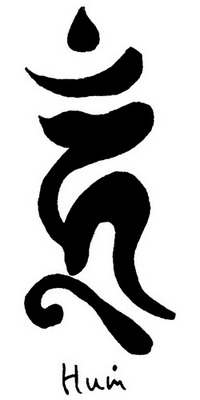
This archetype is depicted in a meditative state (sammai, samādhi) which emits flames (kasho zammai) that destroys all karmic obstacles. Because this archetype the Sovereign of Immovable Wisdom (Fudō Myō’ ō, Achala Vidyā-rāja) never yields to any hindrances whatsoever, he is given the name Fudō, which means “immovable” and “unyielding”. In popular Japanese images, this archetype is represented as a ferocious personage with protruding lower fang-like teeth whose body is indigo in colour and whose person is surrounded by flames. He holds a sword in his right hand and a noosed rope in his left. The Sovereign of Immovable Wisdom (Fudō Myō’ ō, Achala Vidyā-rāja) germ syllable haṁ is on the facing right-hand side of the Fundamental Object of Veneration (gohonzon) that was drawn up by the Patriarch Nikken [67th patriarch of Nichiren Shōshū]. The top of the bindu, i.e., nasalisation, is like a comma on the left-hand side of the ideogram “dai” which in this case means “universal” [as in the four universal sovereigns] of the name Daijikoku Tennō (Dhritarāshtra Mahādeva-rāja). The cross part of this bindu is on the left-hand corner of the ideogram “kokū”. The tail of the main body of this letter – touches the ideograms for Daikōmoku Tennō (Virūpāksha Māhadeva-rāja). With regard to this germ syllable for the Sovereign of Immovable Wisdom (Fudō Myō’ ō, Achala Vidyā-rāja), Nichiren states that this archetype, signifies that “the cycles of living and dying are not separate from nirvana” [which implies the enlightenment of how existence works, i.e., all that the significance of Nam Myōhō Renge Kyō entails]. As well as representing grace, mercy, benevolence or charity, the Sovereign of Immovable Wisdom (Fudō Myō’ ō, Achala Vidyā-rāja) also symbolises perception, in the sense of sagacity (kan), as well as astute insight (chi). All these qualities appertain to the mind (shin, kokoro). 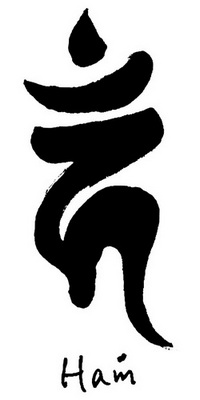
Opposite the Siddham inscription of the germ syllable for the Sovereign of Immovable Wisdom (Fudō Myō’ ō, Achala Vidyā-rāja) on the facing left-hand side of the Fundamental Object of Veneration (gohonzon), we have the germ syllable huṁ for the Sovereign Tainted by Sensuality (Aizen Myō’ ō, Raga-rāja Vidyā-rāja) whose role is to free humans from their troublesome worries (bonnō, klesha) as well as the delusions that stem from our distorted view of things, also on the order of Dainichi Nyorai (Mahāvairochana). On the mandala of the diamond (Kongo, Vajra), which here is a symbol of indestructibility of the Mantra and Tantric School (Shingon), the body of Aizen is red; he has three eyes and six arms. His aspect is ferocious and like that of the Sovereign of Immovable Wisdom (Fudō Myō’ ō, Achala Vidyā-rāja) has fang-like lower teeth. In his hands he holds a bow with arrows. On the Fundamental Object of Veneration (gohonzon) this Sanskrit germ syllable has the implication of “troublesome worries (bonnō, klesha) are not separate from and can lead to (soku) enlightenment” (bonnō soku bodai). This germ syllable is also associated with shiki (rūpa) which means the forms of materiality, as well as sex. This syllable is also related to the Chinese ideogram jō, which is interpreted as samādhi. Samādhi is the intensive contemplation or perfect absorption of thought into one object of meditation or abstract meditation in the realms of form and beyond form. Perfect samādhi is one of the attributes of the hosshin (Dharma-kāya) that is an internal state of imperturbability, exempt from all external sensations. At the same time this germ syllable is connected to the Chinese ideogram kyō (vishaya) which means a region, the environment, colours, forms, sounds, smells etc. Or perhaps this ideogram may be understood as any perception of what we understand as reality. On the Fundamental Object of Veneration (gohonzon) that was transcribed by the Patriarch Nikken, the top point of the nasalisation starts at the upper horizontal stroke of the ideogram “dai” [which means universality] and looks rather like a comma. The moonlike shape of the phonetic sign that indicates nasalisation is on the side of the ideogram for “mon” in the name of Daibishamontennō. The bottom of the body of this syllable reaches down as far as Daizōjōtennō.
The Four Universal Deva Sovereigns (ten’ ō, deva-rāja) At each of the corners of the Fundamental Object of Veneration (gohonzon) there are the ideograms for the four universal deva sovereigns (ten’ ō, deva-rāja). These four universal deva sovereigns (ten’ ō, deva-rāja) are the lords of the cardinal points of the compass – generals who are in the service of Taishaku (Indra) whose role in ancient India was to protect the continents on all four sides of Mount Sumeru. When we face the Fundamental Object of Veneration (gohonzon) that was originally inscribed by Nichiren there are Daijikoku Tennō (Dhritarāshtra Mahādeva-rāja) whose function is to protect the east, situated on the top right corner; Daikōmoku Tennō (Virūpāksha Māhadeva-rāja) whose duty is to protect the west, on the bottom right-hand corner; Daibishamon Tennō (Vaishravana Mahādeva-rāja) whose purpose is to be a guardian of the north, on the top left-hand corner; and Daizōjo Tennō (Virūdhaka Māhadeva-rāja) whose duty is to protect the south, positioned on the bottom left corner. This Fundamental Object of Veneration (gohonzon) is a rectangular-shaped mandala which in general terms is divided into two parts, 1) subjective wisdom (chi) and 2) our individual psychological environments (kyō).
With regard to the word Daishōnin, the “dai” means universal or universally; “shō” means a sage, wise, good, upright, and correct in all his character. The word “nin” in Buddhist texts implies a human being, i.e., the sentient, thinking being, in the dimension where sentient beings have appetites and desires and are incarnated in a subjective materiality with physical surroundings. At the same time, such sentient beings are endowed with the immateriality of the realms of fantasies, dreams, thoughts and ideas (sangai, triloka). The term “shōnin” is the opposite of bonnin, the ordinary, unenlightened person. Hence, those who follow the teachings of the Kōmon Schools use this word [Daishōnin] as an honorific with respect to Nichiren, as the Buddha of the final phase of the Dharma of Shākyamuni (mappō). The word Buddha is derived from the Sanskrit root “budh”, which implies “to be aware of”, “conceive”, “observe”, or “to be awake”. The term Buddha means “completely” and “consciously enlightened” and later came to have the undertone of “the enlightener”. The Sino-Japanese translation of this Sanskrit word implies the idea of “perception”, “being awake and aware”, as well as the gnosis of understanding how and why existence is what it is. The Setsubum Kaiji states that this ideogram means “to be awake”. Its form is derived from the ancient Chinese representation of the word “to see”. On top of this ideogram is the symbol for study, which has been simplified, so as to indicate its pronunciation gaku. There is an Eternal Buddha who is described in the Sixteenth Chapter on the Lifespan of the Tathāgata of the Dharma Flower Sutra (Hokke-kyō), as well as a multiplicity of other Buddhas, who are all emanations of the Buddha Shākyamuni. Since these Buddhas are simply archetypes in Shākyamuni’s psyche, according to Nichiren, these Buddha emanations cannot have the eternal qualities of the Buddha in the Sixteenth Chapter on the Lifespan of the Tathāgata of the Dharma Flower Sutra (Hokke-kyō). In this Sixteenth Chapter, the personality of this Buddha is not defined. The Buddha realm is in and through all things. In the teaching of Shākyamuni, the Buddha’s threefold nature is commonly known as the sanpōbutsu, triratna. Shākyamuni is the first person of this triplicity. His Dharma is the second, and the Order of monks is the third. There are four aspects of the Buddha referred to in the sutric texts. 1) The first aspect is the Buddha of the Particular Teachings for Bodhisattvas – The Buddha seated on the Universally Precious Lotus Flower Throne, under the bodhi tree of the Dharma Flower (Lotus) Realm. 2) The second refers to the Buddha of the teaching of the individual vehicle (shōjō, hīnayāna), who attained enlightenment on the bare ground under the bodhi tree. 3) In the teachings that interconnect those of the individual vehicle (shōjō, hīnayāna) to those of the universal vehicle (daijō, mahāyāna), the Buddha wears a robe that was a present from the deva (ten) and is seated under the bodhi tree, which consists of the seven precious materials. 4) This refers to the two Buddhas in the stupa – Shākyamuni and the Tathāgata Abundant Treasure (Tahō Nyorai, Prabhūtaratna), as representatives of both the subjective and objective views of existence. As it says in the Thesis on the Real Aspect of All Dharmas (Shohō jissō shō), both of these two Buddhas indicate our subjective and objective concepts of existence. But the real Buddha is Nam Myōhō Renge Kyō, which means to devote our lives to and found them on (Nam[u]) the Utterness of the Dharma (Myōhō) [entirety of existence, enlightenment and unenlightenment] permeated by the underlying white lotus flower-like mechanism of the interdependence of cause, concomitancy and effect (Renge) in its whereabouts of the ten [psychological] realms of dharmas [which is every possible psychological wavelength] (Kyō). This is the verbal equation that expresses both the subjective and objective vision of existence, as well as how existence really works.
I personally think that it is of little importance to make a fuss about how we pronounce the Sanskritised Chinese word “Namu”. The letter “u” in Japanese is pronounced in a similar way to this vowel in English, like in the word “put” but with the lips not rounded but left slack. So we have a pronunciation of this word rather like “naahmer” which easily makes it apparent how one pronunciation became confused with the other. What is of greater significance is how we understand the meaning of the word. Namu is the Chinese phoneticisation of the Sanskrit term Namas or the Pali Namo, which means “to make obeisance” or as an expression of complete commitment and is a word that has been constantly used in Buddhist liturgies of all schools. In our practice, Namu is the equivalent of two Sino-Japanese ideograms “ki-myō”. “Ki” on its own, means “to commit oneself to” or “devote oneself to” and “myō” means “life, the length of life”, “to decree” and “destiny”. However, the sixty-sixth patriarch [of Nichiren Shōshū] Nittatsu Shōnin in his sermon on Nichiren’s Nam Myōhō Renge Kyō at the beginning of the Ongi Kuden adds another meaning to this Chinese ideogram “myō” which has the implication of “making the foundation for our lives”, or “something which our lives are based upon” (motozuku). What we devote our lives to, which on the first page of these translations says, “Again devotion means to turn to the principle of the eternal and unchanging reality (shohō jissō),” alludes to the one instant of thought that contains three thousand existential spaces (ichinen sanzen) as it was expounded in the teaching derived from the external events of Shākyamuni’s life and work (shakumon). This means that “to devote our lives to” has all the implications of what has been transcribed on the Fundamental Object of Veneration (gohonzon). The establishment of one’s life means that it is founded on the wisdom of the original archetypal state (honmon) which is reality as it changes according to karmic circumstances. In fact we devote our lives to and found them on (Nam[u]) the Utterness of the Dharma (Myōhō) [entirety of existence, enlightenment and unenlightenment] permeated by the underlying white lotus flower-like mechanism of the interdependence of cause, concomitancy and effect (Renge) in its whereabouts of the ten [psychological] realms of dharmas [which is every possible psychological wavelength] (Kyō), (Nam Myōhō Renge Kyō).
When Nam Myōhō Renge Kyō was first recited The Dharma Flower Sutra (Hokke-kyō) along with Nichiren’s Meaning of the Dharma Flower Sutra are both texts that try to explain the workings of all existence. Some of us remember reading the various books by Alan Watts discussing Zen, in which his translations of various kōan (which are catechistic questions for meditation) all seem to have pointed to the fact that the Dharma which is the expression of the enlightenment of the Buddha is in fact life itself. Somewhat historically later, various monks analysed the concept of the entirety of existence and came up with the answer that the contents of existence are apparently all that is inscribed on the Fundamental Object of Veneration (gohonzon). According to various Chinese records, the Universal Teacher Tendai (T’ien T’ai) (538-597 C.E.) was the first person to recite Nam Myōhō Renge Kyō which means to devote our lives to and found them on (Nam[u]) the Utterness of the Dharma (Myōhō) [entirety of existence, enlightenment and unenlightenment] permeated by the underlying white lotus flower-like mechanism of the interdependence of cause, concomitancy and effect (Renge) in its whereabouts of the ten [psychological] realms of dharmas [which is every possible psychological wavelength] (Kyō). In the Attestations of the Hsiu Chan Temple, the Universal Teacher Tendai (T’ien T’ai), as reported in the daily record of his practice, read and recited the overall essence of all sutras ten thousand times [one hour’s practice]. Later, in the Disclosure of Recondite Masters it says, “This overall essence is the five ideograms for Myōhō Renge Kyō.” This is the proof that the Universal Teacher Tendai (T’ien T’ai), recited the title and theme (daimoku) in whatever way the Chinese of the sixth century was pronounced.
Literally the term gongyō means “diligent practice”. Within the Buddha teaching, gongyō refers to the recitation of sutras in front of either a Buddha image or a mandala, both of which many serve as a fundamental object of veneration. In Japan nearly all Buddhist liturgies are recited in the Japanese reading of the Chinese texts. Already at the time of Nichiren, all persons who were literate could also read and understand classical Chinese, which like Latin in medieval Europe, played the role of the literary language in Vietnam, China, Japan and Korea. The object of these practices, as it was elsewhere, was to emphasise the paths to enlightenment of the various Buddhist schools. Needless to say, the rituals and ways of going about these practices vary from school to school. For people who do the practices of the various Nichiren Schools, the fundamental practice is to recite Nam Myōhō Renge Kyō which, in the Preface of The Oral Transmission on the Meaning of the Dharma Flower Sutra (Ongi Kuden) is intended to mean “to devote our lives to and found them on (Nam[u]) the Utterness of the Dharma [entirety of existence, enlightenment and unenlightenment] (Myōhō) permeated by the white lotus flower-like mechanism of the interdependence of cause, concomitancy and effect (Renge) in its whereabouts of the ten [psychological] realms of dharmas [which is every possible psychological wavelength] (Kyō)”. However, for those people who do the practices of Nichiren Shōshū or kindred rites, gongyō implies first reciting the Second Chapter on Expedient Means up to the point where Buddha Shākyamuni says, “Stop Sharihotsu (Shariputra), don't say anything more”, after which Shākyamuni goes on to define how dharmas make themselves present to any of our six sense organs – eyes, ears, nose, tongue, body, and mind – which for all the various Nichiren and Tendai Schools is the foundation of the principle of the one instant of thought containing three thousand existential spaces (ichinen sanzen). This is followed by the recitation of the whole of the Sixteenth Chapter on the Lifespan of the Tathāgata in which the Buddha explains the indestructible and eternal quality of life. Within the bounds of Nichiren Shōshū and kindred schools, the essential practice is to recite Nam Myōhō Renge Kyō in front of the Fundamental Object of Veneration (gohonzon) and the secondary practice entails the recitation of the first part of the Second Chapter on Expedient Means and the Sixteenth Chapter on the Lifespans of the Tathāgata.
Before discussing the more sensitive question of the Fundamental Object of Veneration (gohonzon), I would like to explain what a mandala is. With regard to the Fundamental Object of Veneration (gohonzon) itself, I will translate what Nichiren says about it in his Threefold (Buddha) Transmission on the Fundamental Object of Veneration (Honzon sando sōden) which was transmitted to and written down by Nichigen. Essentially a mandala is a circle around a cross creating four points much like a compass. In the psychology of C.G. Jung the word mandala is used as it refers to ritual or magic circles which in numerous cultures were and are used as instruments of contemplation. In many texts related to the teaching of Nichiren, mandalas are described as “the place of enlightenment [under the bodhi tree] (dōjō)”, “a stage, rostrum, dais, terrace or altar (dan)”, “endowed with everything (gusoku)” and as “a gathering of meritorious virtues (kudokujū)” etc. In pathology, a child who has to adapt to the outside world is forced to receive a number of psychological shocks, for example, the first day at school, a day which involves surprises, pain, and even being teased by other children, or the sorrow, affliction and the complete confusion that comes from the first experiences with death. Children will now and again see dreams of circular images with a nucleus and possibly they will express these dreams in either drawings or in paint so as to protect themselves against such kinds of trauma. Mandala-like images usually symbolise the very essence of the psyche. If we are to consider a mandala in the light of how our minds work, then coming back to the image of a circle with a cross in it, the point at the very top of the diagram represents thought, the left point of this compass-like image stands for sensation, the right hand point would indicate intuition and the bottom point stands for feeling. Of course these faculties that emanate from the central cross-point can easily be interchanged with each other so as to account for various types of personalities. In terms of anthropology, mandala shapes have existed since Paleolithic times. The cave paintings of Grotta Badisco in Italy apparently point to their use for some kind of religious ceremony. The centre of mandalas nearly always refers to the supreme essence of existence of the users. Within the Buddha teaching there are many kinds of mandala. The real purpose of a mandala is to gather meditative powers together in order to invoke various forces within us so as to deal with the realities of life. Mandalas are not an ointment or cure-all for immediate beatification. The power of any mandala depends on faith, understanding and the sincerity of the person who uses it. No mandala has any intrinsic powers of its own, even though monks of certain temples or the functionaries of powerful lay organisations have done their utmost to fix it in the minds of their followers. This creates a credulous blind belief in an object of veneration that most practitioners cannot even read or understand all of its implications. Such a misrepresentation would open up the idea of a Fundamental Object of Veneration (gohonzon) in Roman script, rather in the same way that the Soka Gakkai has used it as material for instruction.
Among all the different explanations in the sutras on how to attain enlightenment, there exists no argument for being able to arrive at the state of Buddhahood with our respective personalities just as they are, or at least without rejecting our present identities. This concept was first brought about by the school of Tendai (T’ien T’ai), which based its teachings on the Sutra on the White Lotus Flower-like Mechanism of the Utterness of the Dharma (Myōhō Renge Kyō). According to many of the teachings that were taught by Shākyamuni Buddha, before he expounded the Sutra on the White Lotus Flower-like Mechanism of the Utterness of the Dharma (Myōhō Renge Kyō), people could not realise the state of Buddhahood without denying their actual identities of being ordinary people. On the contrary, the Dharma Flower Sutra (Hokke-kyō) makes it possible to become enlightened on the basis of faith, practice, and study. These are the fundamental elements of the teachings of Nichiren Daishōnin. The word “faith” implies a real understanding of Nam Myōhō Renge Kyō, which means to devote our lives to and found them on (Nam[u]) the Utterness of the Dharma [entirety of existence, enlightenment and unenlightenment] (Myōhō) permeated by the underlying white lotus flower-like mechanism of the interdependence of cause, concomitancy and effect (Renge) in its whereabouts of the ten [psychological] realms of dharmas [which is every possible psychological wavelength] (Kyō). Then, one can read the characters on and hold faith in the Fundamental Object of Veneration (gohonzon), as the objectivity of practice. Here, I would like to state that it is not a matter of who is behind what organisation that transcribes the Fundamental Object of Veneration (gohonzon), but what is written on it. [See the Threefold Transmission on the Fundamental Object of Veneration (gohonzon).] The practice is to recite Nam Myōhō Renge Kyō. We in the West may have to learn the implications of this chant, which consists of the title and theme of the Dharma Flower Sutra (Hokke-kyō). We must also make an effort to study and understand all the implications of the Buddha teaching. The most important of these three principles of faith, practice, and study is faith. This faith is a complete trust or confidence that, at some time along the path of this practice, the practitioners can become realised and happy, without any doubts whatsoever. This realisation is comparable to the concept of individuation in the psychology of C.G. Jung. One aspect of the realisation of this teaching is that we can face our respective deaths with the understanding that dying is a part of life. The Dharma Flower Sutra (Hokke-kyō) makes it clear that people can become immediately enlightened. This is often illustrated in reference to the Twelfth Chapter on Daibadatta (Devadatta) in the parable of the Dragon King’s daughter, who became awakened to the meaning of existence in her original form as the daughter of a reptile. This concept opposes the theory that, in order to become enlightened, one must go through various transformations (kaiten no jōbutsu). This meant that a woman had to be reborn a man. [Shākyamuni had a lot of hang-ups with regard to women, as well as having the prejudices of the Indian upper classes or caste.] Or it signified that a wicked person had to become benevolent. Even intellectual seekers were excluded from the attainment of Buddhahood, on account of their egotistical quest for personal enlightenment. Nichiren teaches that any person can be awakened to the meaning of life in one’s present form. The reason is that Nam Myōhō Renge Kyō is the verbal equation of the entirety of existence. What is intended is that we accept life as such, even though there are hardships. What we have to fully comprehend is that the Buddha is life itself, as expressed in many of the riddles (koan) of the Zen School. This of course stands in complete opposition to the idea that the path towards enlightenment demands that people practise over a period of multiple lives and numerous aeons. For those who already practise, we do not sprout wings nor become capable of levitation. But we do become able to fully understand what life is all about, to have a compassion for all beings, as well as to be perfectly happy with existence as it is.
Troublesome worries are not separate from and can lead to enlightenment (bonnō soku bodai) Troublesome worries (bonnō, klesha) are all that goes on in our heads, whether we are immersed in some personal problem or working out the meaning of a sentence in medieval Japanese. Both of these two extremes are what we call troublesome worries in English. This term has also been translated as “passions” or “earthly desire” but the real significance of this term goes far beyond this narrow interpretation. The term means whatever we are doing or whatever is going on in our minds and has all the implications of being alive. This expression is a literal translation of the two Sino-Japanese ideograms “bon” and “nō”. In a number of Japanese dictionaries, the ideogram for “bon” means “trouble” or “worry”. Originally this ideogram was a picture of fire, with the representation of a head. In Discerning the Signs and Explaining the Ideograms (Shuo wên chieh ten, Setsu bun kai ji), the ideogram for “bon” is defined as “headache with fever”. [It is said that the pronunciation is fen in modern Chinese or fan in present-day Cantonese]. The second ideogram in this term is “nō”, which in Japanese dictionaries translates to the English words, “distress”, “worry”, “afflict”, “anguish”, etc. In Discerning the Signs and Explaining the Ideograms (Shuo wên chieh ten, Setsu bun kai ji), it simply says that as regards the ideogram which is used for “nō”, “worry” is a common way of writing an ideogram that is defined in the The All-embracing Dictionary of Chinese Ideograms (Chung Hua ta tzu tien) as “what a jealous woman says to her man”. In terms of the theory of the single instant of thought containing three thousand existential spaces (ichinen sanzen), the concept of the expression “troublesome worries” refers to all nine of the realms of dharmas (hokkai). Next, we come to the Sino-Japanese word “soku” which can be translated as “forthwith”, “not two”, “united together” or “not separate”. The Universal Teacher Tendai (T’ien T’ai) had three definitions: 1) the unity of two things which also have the implication of one being contained in, or leading to, the other, 2) back and front are two inseparables and 3) the substance of the first word mentioned in such equations indicates the quality of the second word. An example would be water and wave. The word “bodai” is a simple transliteration of the Sanskrit word “bodhi” which means “understanding”, “perfect wisdom”, “an enlightened mind” or “enlightenment”. In the earliest Buddhist translations it was interpreted as “Tao”, but later it was translated by words that mean “to perceive” or “to be aware”. In the same way as Shākyamuni’s initial enlightenment in Buddhagāya emanated from and became the Buddha enlightenment of the original archetypal state which is fundamentally and always present in our minds, whatever may be going on in our heads (bonnō, klesha) cannot really be separate from and might even lead to an enlightenment of the meaning of existence.
The cycles of living and dying are not separate from and can lead to nirvana (shōji soku nehan) First in this important Buddhist equation, the Japanese reading of the two ideograms for “nehan” is simply a transliteration into Chinese of the word “nirvana”. However, it might be of interest that whoever invented this transliteration also chose two ideograms that signify “a defiled vessel” in English. Here I think we should look into the concept of nirvana from a Buddhist point of view. Although the word “nirvana” implies extinction, it was originally the state of enlightenment attained by Shākyamuni. Accordingly it means the state which can be reached by extinguishing all illusions and delusions, as well as completely destroying all karma which is the cause of rebirth and for most of us is impossible to do. If we are to understand Shākyamuni’s initial enlightenment in Buddhagāya, then such an awakening to what the real nature of existence consists of must be the Utterness of the Dharma (Myōhō) [entirety of existence, enlightenment and unenlightenment] permeated by the underlying white lotus flower-like mechanism of the interdependence of cause, concomitancy and effect (Renge) in its whereabouts of the ten [psychological] realms of dharmas [which is every possible psychological wavelength] (Kyō) and is Myōhō Renge Kyō which is the eternal indestructibility of life as a fundamental element of existence. Such an awakening could only have originated from the original archetypal state that is the Buddha enlightenment that manifests the life inherent in all of us. Also any real understanding of Myōhō Renge Kyō would have to entail the concept that each single instant of mental activity has to include everything that goes on in our minds. The object of Shākyamuni Buddha’s teaching was to practise for an unmeasured period of time so that the practitioners become so pure that they ceased to exist altogether. This of course is asking too much. In the teaching of Nichiren there exists the tenet that we can become aware of our intrinsic Buddha nature with our persons just as they are and without rejecting our present identities (soku shin jōbutsu). This principle stems from the Tendai School, whose doctrine was founded on the Dharma Flower Sutra (Hokke-kyō). The word “soku” can be translated as “forthwith”, “not two”, “united together” or “not separate”. Living and dying are the enigmatic function of the way existence works. In the Maka Shikan (The Universal Desistance from Troublesome Worries in order to See Clearly), the Universal Teacher Tendai (T’ien T’ai) states, “Everything that comes into being is the manifestation of its intrinsic nature and its ceasing to exist is the return of that intrinsic nature back into relativity (kū).” What this means is that the cycles of living and dying are a fundamental part of the workings of existence.
The One Instant of Thought Containing Three Thousand Existential Spaces (ichinen sanzen) Many, many years ago while living in Katmandu, I was on my way to visit the famous stupa at Bodnath, Nepal. If my memory does not misguide me, I was walking along the road flanked by a wooded grove when a magnificent-looking Hindu ascetic came up to me and said, in very British English, “Young man, what are you seeking?” to which I replied, “I am looking for the truth of what is life,” or something to that effect. Then the sannyasi responded, “We live all space, all time, simultaneously and without effort. Beyond that there is nothing more to learn. Good morning to you.” The years passed by before I fully realised that this elderly sage-like man had taught me a fundamental truth that is barely removed from the Buddhist concept of the “one instant of thought containing three thousand existential spaces”. Sometime later I heard this concept from my Chinese teacher the Venerable Hsin Kuang. It took many years of patient study and practice before I would fully understand that this philosophical and psychological equation is the whole of life, which is Nam Myōhō Renge Kyō. Founding our lives on and devoting them to the location and time of the interdependence of cause, concomitancy and effect entails the whole of existence and is the total celebration of life itself. Even though the Buddha teaching does give room for stimulating prayer, reciting this formula can be used for supplication or beseechment – in time, we can really learn through the experience of practice what our innermost desires and longings consist of. Throughout these translations the term “the one instant of thought containing three thousand existential spaces” has been used exclusively. I shall now try to explain all the implications of this formula. Three thousand (sanzen, trisahasra) is a concept in ancient Indian philosophy that appears to be a number of completeness, possibly because in the Indian countryside there were many who were unable to count. The term “three thousand” was first used to express “the entirety of all dharmas” (issai shohō), a dharma being anything that we can perceive through any of our sense organs or anything that goes on in our heads. So the idea of one instant of thought containing three thousand existential spaces means that even the tiniest fragment of mental activity involves the totality of existence. Even though this numerical theory appears to be somewhat medieval, we might try to understand that in our own western languages, words like life, existence, or water are more or less singularities. For instance, if we say the word “existence” it has something of the undertone of “all existence” or if we just use the word “water” it has the implication of “all the water in the sea” or in the faucet. For convenience, the one instant of thought containing three thousand existential spaces is figured in the following way. The first is the ten [psychological] realms of dharmas. I use this term because the Chinese ideograms define them in this manner. These are the ten realms where dharmas exist as opposed to the whole of existence (Myōhō) which is the oneness of the enlightenment of the Buddha, which in the teaching of Shākyamuni has all the implications of non-existence or nirvana. Nevertheless, each one of these ten realms of dharmas contains the other ten, so that these ten states of mind are all found in one another. In this way, these ten realms of dharmas become one hundred. To this we have to modify one hundred realms of dharmas by the ten ways in which dharmas make their existence felt (jūnyoze) or the ten qualities of suchness, so that we now have one thousand realms where dharmas occur. These one thousand varieties of realms where dharmas come about in various intensities are now modified and multiplied by the three existential spaces, which are, in fact, three principles of differentiation – the 1) existential spaces of the five aggregates (go’on seken), 2) the existential space of sentient beings (shujō seken), and 3) the existential spaces which consist of the environments in which various kinds of existence take place (kokudo seken). Now we have ten [psychological] realms of dharmas, times the ten ways in which dharmas make their existence felt, times the three kinds of existential space. I must say for the sake of putting our various mental states and moods into a schema where they can be grasped with greater clarity, as they are often indefinable at the edges, such as our complexes, joys, angers and sufferings, it is necessary to enumerate and describe each one of these states one by one. The unhappiest realm of dharmas is hell (jigokukai) and the suffering of its denizens. This includes all suffering either physical or mental. Suffering begins at the stage of a thorn in your little finger, feeling the lash of pain caused by words that hurt, the pain of broken relationships, illness, injuries and loneliness, also including the horrors of war and the almost unimaginable dimension of the perpetrators and victims of things that happened during the second World War as well as the current bloodshed in Africa and the Middle East. Hell is also hate. Each one of us has suffered, in some way or another. From a more conventional and stereotypical Buddhist point of view, there are, according to various teachings of the individual vehicle (shōjō, hînayana) or the universal vehicle (daijō, mahāyāna), eight hot hells and eight cold hells, which are situated under the world of humankind. Usually the descriptions of these hells depict them as medieval and sadistic. In their iconographic way these portrayals are far removed from the real pain, suffering and mental anguish that many people experience. Among the objectives of the teachings of Nichiren, one of them is to lead people away from such torments and to bring about their happiness and inner realisation. The second of these ten [psychological] realms of dharmas is the dimension of hungry demons. In the Buddha teaching of Shākyamuni these hungry demons are seen more like ghosts who live in a purgatorial state which some people say is under the ground. It is their sad destiny that they are condemned to continually hanker after food, sex, drink, drugs and other things. It is documented that there are 39 classes of these unfortunate creatures. This dimension is the second of the three lower karmic destinations. In traditional Buddhist iconography these beings are depicted as having long, thin necks with swollen bellies that force them to crawl on the ground. There are also a number of Japanese paintings of the Edo period depicting hungry ghosts hanging around the more sordid and seedy establishments of the red-light districts. The present-day visualisation would be closer to heroin addicts in need of a fix or alcoholic derelicts haunted by their thirst or the tobacco smoker who cannot do without a cigarette. This is the part of us that craves or wants and “must have” in order to continue. From a positive view, the perpetual need for food, nourishment, money etc., is the mechanism to defend the life within us in order to do the things that make life worth living. Again like all the other realms of dharmas, the mental state of the hungry demon is also endowed with all the other ten [psychological] realms of dharmas. In the teachings prior to those of Nichiren, the realm of dharmas of animality (chikushōkai) meant to be born as an animal, even though there must be psychic entities that can only be incarnated in the animal world, such as those beings who were also animals in their former lives. One of the concepts of animality is a sentient being who is motivated by animal instincts and territorialities. Since we humans have also been described by some people as “hairless apes” then perhaps we can recognise that our animal qualities are not only limited to eating, defecation and sex but are also partly responsible for our class systems, hierarchies and feudalism in the office or other workplaces. However, to be born with a human body gives us the opportunity to open up our minds so that we can understand what our existences are all about. The shura (ashura) originally in the brahmanic and Vedic mythology, were originally titanesque beings were always vying with the deva (ten or shotenzenjin) for superiority. Traditionally, they were defined as “ugly”, “not deva” and “without wings”. There were four categories of these beings that depended on the manner of their birth, which means whether they were born from eggs or from a womb or born by transformation or as spawn in the water. Their habitat was the ocean which only came up to their knees; but other less powerful shura (ashura) lived in mountain caves in the west. In popular iconography, the kings of the shura (ashura) were represented with three or four faces and had either four or six arms. They also had palaces and realms similar to the deva (ten). In the teaching of Nichiren this realm of dharmas corresponds to the psychological mechanism of wanting to be the centre of attention, to be noticed by others and the desire to control. Often when these tendencies are frustrated they easily turn into anger, rage and jealousy. In simpler terms it has a lot to do with our being pretentious or a show-off. In the Thesis on the Fundamental Object of Veneration for Contemplating the Mind, Nichiren mentions cajolery, wheedling and “buttering up” as part of this dimension. In a more positive sense, this is the part of us that says that we need our own space which enables us to mentally and physically carry on living, in other words, all that our egos need. The realm of dharmas of humanity (jinkai) is the sense of human equanimity and rationality. In spite of all the troublesome worries (bonnō, klesha) that plague our lives, there is a part that reassures us that things are not as bad as they seem and that everything is all right. It is this aspect of our personalities that gets on with daily living without too many upsets, in other words, a satisfactory life. In the Buddha teaching of Shākyamuni the realms of dharmas of humanity meant to be born as a human being. From the viewpoint of the teaching of Shākyamuni, the realms of dharmas of the deva (tenkai) refer mainly to the merits of the divinities of Brahmanism and other Vedic teachings. The deva (ten) were said to have golden bodies, superhuman powers and extremely long lives filled with joy and ecstasy; but like all other lifespans, at some time or another they must come to an end. Many deva (ten) are the protectors of the Buddha teaching. According to Nichiren’s writing on Securing the Peace of the Realm through the Establishment of the Correct Dharma (Risshō Ankoku ron), one concludes that the deva (ten) protect human interests and that they are also nourished by religious rites especially the recitation of the title and theme (daimoku), Nam Myōhō Renge Kyō. There are many cultures with legends and mythologies concerning this kind of sentient being that would fit into the category of deva (ten), for example, elves, guardian spirits, local gods, saints, angels and ancestral divinities. There are a number of deva (ten) whose names are important to the Buddha teaching of Nichiren Daishōnin and are inscribed on the Fundamental Object of Veneration (gohonzon). One might ask if these tutelary essences could be archaic, archetypal elements in the depths of our psyches that have an influence over our lives in one way or another? When we create so much bad karma by doing things that are wrong, these archetypes can no longer take part in what we do. Then these deva (ten) may no longer make their presences felt, thus allowing more destructive energies to take their place. For anyone who has practised the rites of the teachings of Nichiren, we can only be aware of forces that in some way guide our lives, often in the most unexpected way. What I have just said about the deva (ten) is based on personal intuition. However, someone might ask the question, “What are the deva (ten)?” I thought an allusion to their existence might be food for conjecture. Deva (ten) have extremely happy and ecstatic long lives that eventually must come to an end in a protractedly distant future. The concept of the realms of dharmas of the deva in the teaching of Nichiren refers to our joys and epiphanies like falling in love, getting the right job, a great night out or the enjoyment of doing something useful or creative. However exhilarating or joyful our experiences may be we are always sooner or later compelled to return to the starker dimension of normal realities of daily living. The realms of dharmas of the deva refer to the impermanence of all our joys, raptures and delights. Next we have the realms of dharmas of the people who listen to the Buddha’s voice, which is a literal translation of the Chinese ideograms. In the teaching of Nichiren it refers to the dimension within us that wants to be informed, the desire for intellectual pursuits or just wanting knowledge. This is the part of us that is the inquirer and the part of us where learning is still a work in progress. This concept is applicable to the intellectuals of the present-day. Historically speaking, during the time of Shākyamuni these were the people who exerted themselves to attain the highest stage of the individual vehicle (shōjō, hīnayāna) through listening to the Buddha (shōmon, shrāvaka). [Here I use the term “individual vehicle” because these teachings were for individual enlightenment. We can say that these people were only practising for themselves, as opposed to the practices of the universal vehicle (daijō, mahāyāna) which was an exposition of the Dharma for the people who were prepared to practise not only for the benefit of themselves, but for others as well (bosatsu, bodhisattvas).] Later the expression shōmon was used to designate people who understood the four noble truths – 1) suffering is a necessary aspect of sentient existence; 2) the accumulation of suffering is brought about by our lusts and our attachments to them; 3) the extinction of such suffering is possible and 4) the teaching of the Buddha path leads to the elimination of such lusts and attachments. These people practised with all their might to become arhats or arakan, which is an inner realisation of existence being nirvana or relativity not being separate from the middle course of reality. The object of the teaching of Nichiren, as I have said earlier, is to open up our inherent Buddha nature with our persons just as they are, which is not only within our grasp but a path towards a real fulfillment and realisation. The realm of dharmas of the people who are partially enlightened due to a profound search for the meaning of existence (engaku, hyakushibutsu, pratyekabuddha), is a psychological dimension that is contrasted with the search for understanding and wanting to know the how and why of their circumstances. This realm of dharmas involves those people who have a deep understanding of what life entails but not all its secrets. This kind of mental state is not only concerned with people who follow the various teachings of the Buddha, but also many scientists, writers, artists, musicians, and other people who try and have tried to follow an enlightened existence fall into this category. However, from a historical Buddhist viewpoint, these partially enlightened individuals were those who fully understood the links in the chain of the twelve causes and karmic circumstances that run through the whole of sentient existence. [There are 1) A fundamental unenlightenment which is brought about by 2) natural causes and inclinations inherited from former lives, 3) the first consciousness after conception that takes place in the womb, 4) both body and mind evolving in the womb which leads to 5) the five organs of sense and the functioning of the mind, 6) contact with the outside world, 7) as well as the growth of receptivity or budding intelligence and discernment from the age of six to seven onwards, 8) the desire for amorous love at the age of puberty, and 9) the urge for a sensuous existence, that forms, 10) the substance for future karma, and 11) the completed karma ready to be born again that faces in the direction of 12) old age and death.] Nevertheless, the Buddha Shākyamuni saw people of the realm of dharmas who were partially enlightened due to a profound search for the meaning of existence (engaku, hyakushibutsu, pratyekabuddha) as essential seekers of enlightenment for themselves. The realm of dharmas of the bodhisattva (bosatsukai) is the ninth of these ten [psychological] realms of dharmas. Originally this term bodhisattva is derived from two Sanskrit words, 1) bodhi which means knowledge, understanding, perfect wisdom, or enlightenment and 2) sattva which has the sense of being, existence, life, consciousness or any living sentient being. While this concept is not entirely foreign to the teachings of the individual vehicle (shōjō, hīnayāna), it was used almost exclusively to designate Shākyamuni in his former existences. In tales concerning the former lives of the Buddha, he is often referred to as the Bodhisattva. According to the earlier teachings of the universal vehicle (daijō, mahāyāna), this expression referred to any person whose resolve was to attain enlightenment, which in Chinese texts was understood as “a sentient being with a mind for the universal truth”. Later the term bodhisattva (bosatsukai) was used for people with an awareness that was all-embracing. In the teachings of the universal vehicle (daijō, mahāyāna), the people who listened to the Buddha’s discourses (shōmon, shrāvaka) and those people who were partially enlightened due to a profound search for the meaning of existence (engaku, hyakushibutsu, pratyekabuddha) only made endeavours for their own enlightenment, whereas the bodhisattva aims at the illumination and the realisation of others. Roughly speaking, this realm of dharmas designates the desire to seek one's own enlightenment and at the same time, have the compassion to strive for the happiness of others. The tenth of the realms of dharmas is that of the Buddha enlightenment. To describe this psychological dimension is the most difficult, since such an enlightenment is beyond any of my personal experiences. This realm of the Dharma is the oneness of existence as perceived by the Buddha. This perception of the singularity of the Dharma is understood as one of total freedom and a consciousness of the ultimate truth. The Dharma Flower Sutra (Hokke-kyō) makes it clear that the Dharma Realm of the Buddha is inherent in the lives of all sentient beings. As an experience, this dimension is probably the clear light that is often seen by people in near-death states, which in the Tibetan Book of the Dead (Bardo thos sgrol) is described as “the point of entering the intermediary state between dying and rebirth” (hchi khahi bar do). In the teaching of Nichiren this is pointed out as “the silence and the shining light” that is in fact the fundamental nature of life itself, which also accompanies us through our respective deaths. It might be possible to define the Dharma realm of the Buddha (bukkai) as life and all that Myōhō Renge Kyō implies. These ten [psychological] realms of dharmas are in fact ten states of mind and also the dharmas that contribute to the composition of these mental and emotional conditions. That is the reason for using the term “realms of dharmas”. Just as in our ordinary lives there can be no experience that is not tinged with all the other things that have happened to us in our respective lifetimes – for instance no suffering is separate from all the other events in our existences – there cannot be any anger that is not correlated to what happened to bring about such a situation. It is the same with all of these realms of dharmas, none of which exists entirely on its own. The mutual possession of the ten [psychological] realms of dharmas is a concept of the Universal Teacher Tendai (T’ien T’ai) based on the teaching of the Dharma Flower Sutra (Hokke-kyō). Here Tendai (T’ien T’ai) propounds that each one of these realms of dharmas contains the latent potentiality of the other ten. This is one of the concepts that form the basic structure of the theory of the one instant of thought containing three thousand existential spaces (ichinen sanzen). The mutual possession of the ten [psychological] realms of dharmas implies that our lives are not rooted in any one particular realm. But at any moment any one or more realms of dharmas can become manifest if there are the right karmic circumstances. One of the more important implications of this concept is that all ordinary people who normally inhabit the first nine of the realms of dharmas, such persons can open up their inherent Buddha nature with their individualities, just as they stand. In addition to this, the Buddhas are also endowed with the first nine realms of dharmas and are fundamentally the same as we who are common mortals. The idea of the reciprocity of the ten [psychological] realms of dharmas can produce the notion that people have a propensity towards a particular realm of dharmas. However, through continual practice and study, people can come to realise that their real identity is the essence of life itself. As I explained earlier, each realm of dharmas is furnished with the other ten, giving us a total of one hundred realms of dharmas. The ten ways in which existence can become perceptible to our various senses, or the ten qualities of suchness (jūnyoze) – which literally mean these ten factors of existence are “just like this” (nyoze=kaku no gotoki) – is an analysis of existence which included all its changing aspects. Consider that machines used in modern hospitals can scan the human body, layer by layer, and other devices can view objects on a molecular level. While orbiting around Earth, the Hubble Space Telescope allows astronomers to observe distant supernovae and uncover evidence that the universe is expanding at a greater rate than previously thought. The total human knowledge, driven mostly by technology is now doubling every four years and will continue to do so. Yet, the ten ways in which dharmas make themselves perceptible to our six senses remain the same. The Buddha Shākyamuni first expounded these ten qualities of suchness in the Second Chapter on Expedient Means of the Sutra on the White Lotus Flower-like Mechanism of the Utterness of the Dharma (Myōhō Renge Kyō, hōben bon dai ni), where he says, “Stop, Sharihotsu (Shariputra), don’t say anything more. The reason is that what the Buddha brought to perfection is the most awe-inspiring, primary, and difficultly understood Dharma. “The real aspect of all dharmas (shohō jissō) can only by exhaustively scrutinised between one Buddha and another. What this real aspect is said to be is (sho’i shohō) 1) in any way dharmas make themselves present to any of our six sense organs (i. eyes, ii. ears, iii. nose, iv. tongue, v. body, and vi. mind (nyoze sō), 2) their various inner qualities (nyoze shō), 3) their substance or what they really are (nyoze tai), 4) their potential strength and energy (nyoze riki), 5) the manifestation of that energy and strength which is their influence (nyoze sa), 6) their fundamental causes (nyoze in), 7) along with their karmic circumstances (nyoze en), 8) the effects they produce (nyoze ka), and 9) their apparent karmic consequences (nyoze hō). 10) Also any way dharmas make themselves perceptible to any of our six sense organs has coherence with ‘their apparent karmic consequences’, which are present in every instant of life (nyōze hon makku kyō tō).” This particular text gives us a foundation and a reason for replacing the three categories of vehicles to enlightenment with the single vehicle. The three vehicles are 1) the hearers of the Buddha’s voice, who were people who exerted themselves to attain the highest stage of the individual vehicle (shōjō, hīnayāna) through listening to the discourses of the Buddha or the intellectuals of today (shōmon, shrāvaka), 2) people who are partially enlightened due to a profound search for the meaning of existence (engaku, hyakushibutsu, pratyekabuddha) and 3) the bodhisattvas (bosatsu) who seek enlightenment not only for themselves, but for others as well. This concept was expounded in the teachings derived from the external events of Shākyamuni’s life and work (shakumon) which stand in contrast to the doctrine that refers to the original archetypal state of existence (honmon). The teachings derived from the external events of Shākyamuni’s life and work tend to have a somewhat theoretical, presumptive and academic flavour. Nevertheless, be that as it may, those ten ways in which existence can become manifest, or these ten ways in which dharmas make themselves perceptible (jūnyoze) are applicable to all dharmas, in such a way that there cannot be any real distinction between the Buddha and ordinary people. The process of clearing away these three vehicles to enlightenment in order to establish the single vehicle is referred to as “clearing away the three vehicles in order to reveal the one”, or kai san ken ichi in Japanese. The Universal Teacher Tendai (T’ien T’ai) takes advantage of the authority of this passage in the sutra in order to establish the theory of the one instant of thought containing three thousand existential spaces (ichinen sanzen). Whereas the ten [psychological] realms of dharmas express different states of mind and their illusory accompanying states of affairs, the ten qualities of suchness, or the ten ways in which existence can become perceptible (jūnyoze), can be applied to any existential situation whatsoever. In this way both the realms of suffering (jigokukai) and the realm of the enlightenment of the Buddha (bukkai), in spite of their differences, have the ten ways in which existence can be perceptible (jūnyoze) in common. Let us review these ten ways in which existence becomes apparent (jūnyoze). Nyoze sō which is in any way that dharmas make themselves present to any of our six organs of sense – the same way they become perceptible from the outside which includes attributes such as colour, shape, composition, behaviour, and every other physical aspect. Nyoze shō refers to the various inner qualities of dharmas, the words that we attach to them, those thoughts that we associate with them along with the characteristics that cannot be discerned from the outside. When it comes to human beings, it refers to their psychological makeup, spiritual individualities and consciousness. Nyoze tai is the substance of what beings or things really are, which is a combination of their physical and psychic aspects. When it comes to the inanimate, it includes the various mental or spiritual features that we would like to assign to them – for instance what a child might endow its teddy bear with – or what we might asttribute to a religious image along with all the special qualities that the devotee might attach to it. These first three qualities of suchness (nyoze) refer to the triple axiom of reality (santai) – 1) that existence is only its physical attributes (ke) which, in terms of these first three ways in which we perceive dharmas is nyoze sō. 2) The second is existence which is the relativity and immateriality of the relativity and noumena and can only be reached through our minds (kū, shūnyatā), which in this case is nyoze shō. 3) The third of these threefold explanations is the reality of all dharmas which is a combination of the two aspects of reality ke and kū, which I have just explained. This is the middle way of reality (chūdō jissō) and in terms of the qualities of suchness is nyoze tai. The following six qualities of suchness, beginning with “their potential, strength and energy (nyoze riki).”to “their apparent and karmic consequences (nyoze hō)”, are the functions, the various ways, and intensities of the workings of life. “Their potential strength and energy (nyoze riki)”, which is the fourth quality of suchness, represents the force or the potential energy, in order to realise something in our lives or to set an action in motion. The fifth quality is “the manifestation of that energy and strength, which is their influence (nyoze sa)”. This is the action that comes about when the latent potentiality is set into motion. The sixth quality of suchness is “their fundamental cause (nyoze in)”, that is, the causes inherent in our lives which produce an effect, which is either positive, or negative or neutral. The seventh quality is “along with their karmic circumstances (nyoze en)”, which is understood as a contributing cause or a concomitancy. A karmic circumstance is a condition or a situation that contributes to an effect. The eighth quality is “the effects they produce (nyoze ka)” that are the result of what happens in the depths of our lives, especially when there are karmic circumstances to bring such an effect about. Since the fundamental causes and the dormant results are somewhat latent in the deeper trenches at the bottom of our existences, there is often a certain lapse of time between the manifestation of that energy, and the strength and the action that it caused, and the effects that actions can produce. “Their apparent karmic consequences (nyoze hō)" is the ninth quality of suchness. This is the concrete result that appears after an unspecified period of time, as the consequence of both “the fundamental causes” “along with their karmic circumstances”. Also any way dharmas make themselves perceptible to any of our six sense organs [i. eyes, ii. ears, iii. nose, iv. tongue, v. body and vi. mind] have coherence with “their apparent karmic consequences”, which are present in every instant of life or death (Nyōze hon makku kyō tō). This last and tenth of these qualities of suchness is the integrating link between the way dharmas make themselves present to our six sense organs (Nyōze so) and their apparent karmic consequences (nyōze hō). These ten qualities of suchness are continually present to some degree or another throughout the whole of existence. The first three of these ten qualities of suchness (sō, shō, tai) are grouped together and collectively defined as the substance of any dharma or any being that exists. The following six qualities of suchness (riki, sa, in, en, ka, hō) are the various functions and qualities of all dharmas. All those ten ways that dharmas can become perceptible are inseparable from each other. This in fact is what the substance and the roles of the whole of existence consist of. In the theory of the one instant of thought containing three thousand existential spaces (ichinen sanzen), these ten ways in which dharmas make themselves perceptible (jūnyoze) modify the hundred realms of dharmas. Ten times the hundred mental states that have already been mentioned become a thousand qualities of suchness. It might also be of interest that these ten qualities of suchness are not mentioned in the original Sanskrit text of the Dharma Flower Sutra (Hokke-kyō). One can assume that Kumarājîva (Kumarajū) was making Shākyamuni’s preaching more explicit. This is precisely what we are doing with these interpretive translations. In conclusion to the theory of the one instant of thought containing three thousand existential spaces (ichinen sanzen), we come to the three existential spaces upon which sentient beings depend in order to exist (san seken). These three existential spaces are in fact three formulas for the differentiation that exists between one person and another. The first is the existential spaces of the five aggregates (go’on seken); the second is the existential spaces of sentient beings as individuals (shujō seken); and the third is the existential spaces of individual environments (kokudo seken). Although these concepts have their origin in the writings of Nāgārjuna (Ryūjū), they were assimilated by the Universal Teacher Tendai (T’ien T’ai) as the third supposition to support his meditational perception of the one instant of thought containing three thousand existential spaces. It is worth mentioning that the Universal Teacher Tendai (T’ien T’ai) is generally considered to be the Buddha of the formal period of the Dharma (zōbō). The five aggregates (go’on) are the elements that are the makeup of living beings, and the existential spaces (seken) are where sentient beings do what they do, or where they live and die. These five aggregates are the following: 1) Shiki which is the physical aspect of any living beings which also includes five of their six organs of sense [i. eyes, ii. ears, iii. nose, iv. tongue, v. body] with which the external world however illusionary can become perceptible to them. 2) Ju is the function of taking in external information through our various sense organs including the mind that coordinates the impressions of the first five senses. 3) Sō is conceptualisation and thought. It is the way beings apprehend and form some kind of idea of what they have experienced. 4) Gyō is the decision to take on a course of action on account of what our minds have understood, thus having formed an idea of what to do, which is often ways of behaving from former lives. 5) Shiki, which is written with a different ideogram from the first aggregate, is the consciousness that has the function of discerning and the ability to distinguish one thing from another. Our consciousness can also establish opinions and store them up. This last aggregate integrates the other four. The first aggregate refers to our physical aspects while the other four signify our mental behaviour. The existential spaces of sentient beings as individuals (shujō seken) consists of a temporary union of the five aggregates, as mentioned. So we are what we are from one moment to the next because living beings or sentient beings are only expressions that refer to this mutable instability of the five aggregates (go’on) that give us the impression we are conscious individuals. Whereas the significance of the five aggregates analyses the physical and mental workings of a sentient being, the existential spaces of sentient beings as individuals (shujō seken) designates a personality that is already established and is capable of functioning in relationship to its environment. This is a concept which implies what sort of sentient beings we are. Are we denizens of hell, wild animals in the forest or ecstatic deva (ten) above the world? At the same time, this idea can be covered with a notion of plurality, which suggests various groups of people. For instance, are we French or Japanese? The existential space of individual environments (kokudo seken) specifies the places which sentient beings inhabit and where their activities take place. This concept essentially differs from the ten [psychological] realms of dharmas (jikkai), in the sense that they are varying states of mind, whilst the existential spaces of individual environments are the manifest surroundings and conditions in which different kinds of sentient beings live. Originally, in the teachings prior to those of Nichiren, the existential spaces of individual environments (kokudo seken) were actual physical locations. For instance, people who suffer were placed in various hells under the ground due to their karma. The ecstasies of the deva (ten) dwelt in a heavenly rapture, somewhere high above the world. However, since the ten [psychological] realms of dharmas are subjective experiences, then the existential spaces of individual environments also reflect the various aspects of life that are our own karmic fabrication. As we continue with the theory of the one instant of thought containing three thousand existential spaces (ichinen sanzen), we now have three existential spaces upon which these thousand qualities of suchness (nyoze) are able to act out their respective modes of being. Both Dr. Soothill’s Dictionary of Chinese Buddhist Terms and the Universal Dictionary for Buddhist Studies (fo hsueh ta tzŭ tien) of Ting Fu-pao list the entry for three thousand (sanzen) as a technical term to express all things everywhere, in other words, all dharmas (issai shohō). Hence the idea that one flash of mental activity pulls along with it the whole of existence. This is the same as the one instant of thought containing three thousand existential spaces (ichinen sanzen).
The theory of the fixed principle of the true nature of existence (fuhen shinnyo no ri) The theory of the fixed principle of the true nature of existence (fuhen shinnyo no ri) is the axiom of existence and the fundamental principle of the true form of things, the counterpoint of the concept of the wisdom of “the true nature of existence that changes according to karmic circumstances (zuien shinnyo)”. This true nature of existence (shinnyo, tathatā) possesses both pure and impure aspects. In the Dharma Flower Sutra (Hokke-kyō), the concept of the theory of the fixed principle of the true nature of existence is expressed in the Second Chapter on Expedient Means in terms of the real aspect of all dharmas (shohō jissō), which entails existence from a subjective viewpoint. In this sense, it only comprises ten times the ten realms of psychological dharmas, multiplied by ten ways in which dharmas make themselves present to any of our six organs of sense. But it does not clearly state as to where and how these dharmas occur. According to the Thesis on the Awakening of Faith in the Universal Vehicle (Daijō kishin ron) by Asvagkosha (Meimyō), which was translated by Daisetz Suzuki in the nineteen-thirties, the true nature of existence (shinnyo, tathatā) is regarded as the fundamental of the mind of sentient beings and is the essence of life itself, whereas the true nature of existence which changes according to karmic circumstances (zuien shinnyo) is subject to activation by our inherent ignorance (mumyō, avidyā). The true nature of existence is eternally pure. It is the part of us that never came into being, nor does it ever cease to exist. It is the enlightenment within us – the silence and shining light that are in fact the real and fundamental nature of life itself.
The wisdom with regard to the true nature of existence that changes according to karmic circumstances (zuien shinnyo) is exactly as this phrase expresses it, and is the counterpart of “the theory of the fixed principle of the true nature of existence (fuhen shinnyo)”. In the teaching of Nichiren Daishōnin, thusness, suchness, the true aspect of reality (shinnyo, tathatā), is regarded as the fundamental mind of sentient beings, which is relativity (kū, shūnyatā). However, there are two aspects of suchness that is the “true aspect of reality (shinnyo, tathatā)” and is, in actual fact, mind, since the reality of objective existence is open to question. Whatever existence may be, it is the clear light of nirvana and is the Dharma nature (hōsho, Dharmatā). But, at the same time, when the Dharma nature is filtered or, rather, polluted by our respective personalities, it becomes the true nature of existence that changes according to karmic circumstances (zuien shinnyo). In the teaching of the original archetypal state (honmon) of the Dharma Flower Sutra (Hokke-kyō), it is said that this true nature of existence that changes according to karmic circumstances is whatever sentient beings do. To be able to fully understand these two aspects of existence, it is the wisdom with regard to the true nature of existence that changes according to karmic circumstances (zuien shinnyo no chi) and, as Nichiren states, “This concept implies the nine realms of psychological dharmas of ordinary existence and is not separate from the oneness of the enlightened realm of the Buddha (Myō) or Utterness. It is the Dharma realm or enlightenment which is Nam Myōhō Renge Kyō and its implications, and the nine realms of dharmas (hō) stand for unclearness and unenlightenment. So when unclearness and enlightenment become a single entity, it is called the Utterness of the Dharma (Myōhō, Saddharma).”
All the inanimate objects in our surroundings, such as trees, vegetation, along with all the other things that have no emotions or consciousness, can reveal their inherent Buddha nature. This is a concept derived from “the single instant of mental activity containing three thousand existential spaces” (ichinen sanzen), which was formulated by Tendai (T’ien T’ai). This concept is based on the idea of “the objective terrain upon which we depend for an existence” (kokudo seken). This notion is expressed in The Real Aspect of All Dharmas (Shoho jisso sho), where Nichiren writes: “If there is a karmic requital (hō) or the environment upon which we depend for an existence, then there is certainly a corresponding karmic requital (hō) on our subjective vision of life.” In the theory of “each instant of mental activity containing the whole of our psychological potential in the background” (ichinen sanzen), it is implied that sentient beings are mentally inseparable from their environments, which unavoidably include every kind of inanimate object. Enlightened persons would, with all their six senses, perceive every appearance of their existence as evidence of their Buddhahood, as has often been recounted in the “koan” of the Zen School. Less fortunate persons may only perceive their existence, as Aldous Huxley puts it, as “the grey world”. The Discourse of the Diamond Scalpel (Kongobei ron) [here the word “Diamond” stands for the indestructibility of the real suchness of existence (shinnyo, tathatā)] affirms that vegetation and objects that have no emotions or feelings are also endowed with the Buddha nature. “A tree, a plant, a pebble, or even a grain of dust all contain the intrinsic nature of Buddhahood, as well as the causes and conditions to be able to open up their inherent enlightenment.” There are two ways in which our inanimate environments can attain the realisation of inherent Buddhahood. One is that, if someone becomes enlightened, then all of that person’s surroundings will automatically attain Buddhahood. The other way is that, when the enlightenment of the Buddha is inscribed on the Fundamental Object of Veneration (gohonzon), both the sheet of paper, upon which the enlightenment of the Buddha is inscribed, or the piece of wood, upon which the realisation of Buddhahood has been engraved, are also impregnated with the enlightenment of the Buddha. This is referred to as “opening up one’s inherent Buddha nature with our respective personalities just as they are (soku shin jōbutsu)”.
The Buddha Teaching as a Protection and the Tatsunokuchi Incident Even my Chinese teacher, Hsin Kuang, emphasised that the Buddha teaching was in itself a protection, as well as being a path towards the most important realisation in all our many lives. The most outstanding example is how the Dharma saved Nichiren from being executed at Tatsunokuchi. Just at the moment when Nichiren was about to be decapitated, a luminous entity crossed the sky from the southeast, terrorising the soldiers so much that they were incapable of carrying out the beheading. We know that the education of Nichiren consisted of the teachings of Tendai (T’ien T’ai), as well as those of the Tantric School, which was referred to as the Tendai Mikkyō Shū. This raises a blatantly obvious question – how could it be that, in an age when knowledge was scarce and unavailable, Nichiren was completely familiar with the Siddham alphabet, along with having a full understanding of mandalas? Therefore, it was highly probable that Nichiren was familiar with Yogic teachings similar to those of the Tibetan Book of the Dead (Bardo Tos Sgrol). We must bear in mind that Nichiren was about to be beheaded, which was a highly stressful situation, to say the least. Since he was aware of the clear light (hosshin, Dharma-kāya) and, at the same time, had a complete understanding of the workings of existence (Nam Myōhō Renge Kyō), it would not be surprising for a person whose faith was that of the fundamentally enlightened, and whose personality was imbued with the whole of the Buddha teaching, to have had a vision of the clear light immediately before his death. Nevertheless, it goes beyond that. Other people saw this vision, too. One can only surmise that there was a mechanism similar to psychokinesis. This was the manifestation of the hosshin (Dharma-kāya) that can only be what existence is itself.
Instead of an Anglo-centric interpretation, how should we call the religious functionaries of the various orders of the Nichiren Schools? It is not so much a question as to whether these persons hold to the precepts (vinaya) of the Buddha teaching of Shākyamuni or not, but as to how they see and refer to themselves. They do not take themselves to be “bokushi” or “shisai” which are standard words for priest in modern Japanese. Instead they call themselves “gosōryo”. The Japanese, “go” is an honorific prefix that is also found in the words “gohonzon” or “gojukai”. In Gilbert and Sullivan’s light opera, “The Mikado”, this prefix becomes the Pidgin English “honourable”. The sō part of this term is an abbreviation of the Chinese transcription of the word for “sangha”, which in present-day Cantonese is “sang ka”. The languages of Southern China are often seen as fossilisations of the Medieval Chinese in the same way as Icelandic is thought of as an older form of Norse. In time, the syllable “ka” had been dropped away from this term, because the Chinese like to keep their expressions simple. The Japanese reading of this “sang” ideogram is “sō” which is a sound that has been tailored to suit the limits of their phonetics. The word “ryo” means a companion or a follower. The term “gosōryo” literally means “an honourable member of the sangha”. Such an expression can only be understood as a monk or even a friar, even though these monks would like to see themselves as priests, as they occasionally officiate at religious ceremonies; but so do the Franciscan friars in Latin countries today.
Terms and concepts common to all Buddhist teachings
Before discussing the intricacies of the Fundamental Object of Veneration (gohonzon), I have to say that the way the Buddha teaching is being taught, by each and all schools here in Japan, amounts to little more than coercing people into a low-level credulity and superstition. This declaration is particularly applicable to the monks in Taisekiji Temple. To begin, with Nam Myōhō Renge Kyō is a title and subject matter that consists of words and not some silly magic spell which, if chanted, will get the practitioners anything they might want. Nor is the Fundamental Object of Veneration (gohonzon) a numinous shamanistic charm which, if chanted, at will comply with any desire that suits the fancies of the votary. If one were to attentively read the first entry of The Oral Transmission on the Meaning on the Dharma Flower Sutra (Ongi Kuden) that is a part of this web project – which is also the recording of Nichiren’s intention and possibly his words written down by his closest disciple Nikkō Shōnin – then it might become possible that the meaning of this title and theme (daimoku) is to devote our lives to and found them on the Utterness of the Dharma (Myōhō) [entirety of existence, enlightenment and unenlightenment] permeated by the underlying white lotus flower-like mechanism of the interdependence of cause, concomitancy and effect (Renge) in its whereabouts of the ten [psychological] realms of dharmas [which is every possible psychological wavelength] (Kyō). The Oral Transmission on the Meaning of the Dharma Flower Sutra says that the word “heard”, of what was heard, implies the second of the six stages of practice, which is the stage of when people hear the title Nam Myōhō Renge Kyō and also read the sutra (i.e., recite gongyō). They are then able to reason that all existence is endowed with the Buddha nature and are able to open up the Buddha nature within themselves. The meaning of the Dharma is Nam Myōhō Renge Kyō. In regard to being able to hold to the Dharma, one should then think very carefully over the word “able”, which refers to our personal capabilities. What this formula in Sanscritised Chinese entails is that we are devoting and returning our lives to the very essence of what life really is. If one is patient enough to assimilate the significance of this title and theme, as well as reciting it many times in front of the Fundamental Object of Veneration (gohonzon), we will gradually acquire wisdom, understanding, and happiness, as well as knowing what our lives are all about. Equipped with this somewhat deeper insight, we can more easily make headway through the thorns and brambles of our respective existences. This gives us the subjective illusion that we are receiving benefits through our practice. But, in actual fact, these benefits are the reward for our faith in the existence of the realm of the Buddha in our lives, as well as having grown up in what is often not always a benevolent world. Where the problems with our teaching really begin is that we are bedazzled and somewhat confused by the swaying robes of the monks, as they piously strut along. Apart from one or two brave individuals who have made enormous efforts to learn local European languages and customs, for the most part, I have never met a single monk with whom I could easily talk with in English. As far as the West is concerned, perhaps the only way to follow this teaching is to practise and study on our own. A lot of translations of Buddhist texts exist in many European languages. We also have a rich tradition of the psychology of the profound. Here I would like to emphasise that the strength of the Western mind is curiosity. In order to fathom the depth of Nichiren’s Buddha teaching, it might be necessary to plough our way through everything that has been written. Because the Buddha teaching exists in Sanskrit, Pali, Tibetan, and all languages that use Chinese ideograms which, in this case, also includes Vietnamese – and most people who do the practices of the teachings of Nichiren are incapable of seeing the difference between the original version of the booklet of our devotional daily practice and a Chinese restaurant menu – I think it might be better to accentuate that the object of the Buddha teaching is to make us a little more aware of what our existences are all about. I also would like to stress the point that we should do our practice with a full awareness of what we are reciting and reading. One of the most crucial questions asked by someone who practices the rituals of the teaching of Nichiren Daishōnin has to be, “What in the hell am I doing and why?” Then a possible answer might be that the practises of the various Nichiren Kōmon schools are a constructive and deep psychological exercise to bring about an individuation, which makes us realise that our identities are life itself. But such a psychological process does not imply praying to a god for a bag of sweets. Even though the Buddha teaching does give room for prayer and supplication – a series of solemn requests or thanksgiving to the Fundamental Object of Veneration (gohonzon) can help to lessen severe physical or psychological pain – this is not the real object of our teaching. One of the established and widely-accepted principles in the teaching of Nichiren is that our troublesome worries (bonnō, klesha), which are all the things that swirl around in our heads – from sex fantasies to working out the intention of a sentence in Classical Chinese or our efforts to absorb the implications of a mathematical equation – all these mental events are not separate from life itself. Another principle that illustrates this is in the cycles of living and dying. The sense that sentient existence has always existed and goes on forever is in no way separate from who and what we are now. What we conceive of as being alive is only what we have arranged or disarranged in our heads. The enlightenment of the Buddha Shākyamuni was, in essence, nirvana, which means that it was a state which could be reached by extinguishing all our illusions, attachments, worries as well as the various dispositions we have inherited from former lives which are, in fact, karma and the cause of rebirth. This of course is something that is extremely difficult to accomplish, except for somebody like a Shākyamuni. For ordinary people such as we are, Nichiren’s compassion and sympathy for all of us is that he teaches us to be aware of and to awaken our inherent Buddha nature, with our respective bodies and personalities and all their little oddities, just as we are. Whereas the enlightenment of Shākyamuni is the realisation that existence can be extinguished in nirvana as a way out of all kinds of suffering, the enormous realisation of Nichiren’s understanding of the Dharma Flower Sutra (Hokke-kyō) is that he makes no distinction between an unattainable nirvana and the realms of dharmas which we all inhabit.
Mount Sumeru (Shumisen) was the mountain that stood in the centre of the world, according to ancient Indian tradition. It was said to have measured 84,000 yojanas above the earth and another 84,000 yojanas underneath the surface. It was considered that a yojana was a measurement defined by a day’s march of the royal army, which would add up to something close to thirty kilometres a day. Tradition states that Mount Sumeru was made of gold, silver, emerald, and crystal. The mountain had four slopes, each one facing in the four directions of north, south, east, and west. The Deva Taishaku (Skt. Shakra Devanam Indra) has his palace on the summit, whereas the four heavenly deva kings [as inscibed on the Fundamental Object of Veneration (gohonzon)] live halfway up its four slopes. Mount Sumeru is surrounded by seven concentric circles of mountain ranges that are of solid gold between which there are seven seas of perfumed water. The seventh mountain range is surrounded by an ocean of salty water, in which the four continents of Hotsubudai, Kuyani, Uttanotsu, and Enbudai are situated accordingly, in the east, west, north, and south. The world of humankind is Enbudai. Above the summit of Mount Sumeru, there are various heavens in which some of the inhabitants have desires and appetites; other heavens have inhabitants that have formed along with their surroundings; other heavens have inhabitants that consist of the immateriality of being without any form at all. There is a sun and moon that rotate around this cosmos, and the salty ocean is surrounded by a circular range of iron mountains which form the outer limits of this universe. However, here I would like to emphasise that, from the point of view of faith, there is no contradiction between these ancient psychological concepts as the experience of being alive and our present-day view that is based upon scientific thought, along with the psychological and philosophical research of C. G. Jung, Aldous Huxley, R. D. Laing, and many others. Although this description of Mount Sumeru is somewhat sketchy, it might be worth pointing out that the cause of its existence is none other than the karma of those whose consciousness has survived the dissolution of other universes.
Before delving into the question of the enormous numbers mentioned throughout the Dharma Flower Sutra (Hokke-kyō), I thought it might be wise to quote the Zen monk Nansen (Nan Ch’üan) (748-834 C.E.), in order to have a kind of instruction as to how we might look at these apparent improbabilities that we encounter throughout this and many other sutras. Nansen said to the assembly of monks, “We know nothing about the existence of the Buddhas of the past, present, and future;, all we know by experience are things like badgers and white bulls.” What Nansen was trying to point out is that we have no means of really understanding what a great deal of the arcane and unrevealed content of the sutras really means. All we can actually experience are the realities of our day-to-day lives. However, in spite of the hermetic quality of so many of these kinds of references, it does not prevent us from making a qualified guess. I am personally prepared to accept that what the Buddhas such as Gautama Shākyamuni or Nichiren Daishōnin have said is the truth. I have also tried to make sense out of what the implications of those enormous astronomical numbers are. If we are prepared to accept the idea of the one instant of thought containing three thousand existential spaces (ichinen sanzen), along with the concept that plants, trees and the environment have an inherent Buddha nature, then perhaps we can become adjusted to the notion that anything that exists must entail the whole of existence, or that any single being or object cannot be separate from the entirety of life. In the theory of Tendai (T’ien T’ai), we have only three thousand kinds of existential spaces, but, in our experience of everyday reality, the number of psychological wavelengths that exist at any given moment would automatically involve the enormous numbers of ciphers that are dotted about here and there throughout this sutra. All we can presume is that these myriads of myriads of myriads that are often mentioned in the sutric text might suggest that, whatever our individual realities may be, we live all space, all time, simultaneously and without effort.
One of the more difficult words encountered in Buddhist studies is Dharma with a capital “D” and dharma with a lowercase “d”. Dharma, when it is written with a lowercase “d”, refers to anything that touches upon our senses, whether it be seeing, hearing, tasting, smelling, or something conjured up in our minds. Although Buddhas perceive existence as a oneness, we ordinary people tend to see existence as an enormous agglomeration of all sorts of different items – tables, chairs, pencils, music, sounds outside or inside the house, smells, and the search for words in our heads. Whatever anything may be, it is a dharma which, in Japanese, is hō. Nichiren, in many of his theses, uses the word hō (dharma) in this way. For those who study the Buddha teaching, the word dharma is very convenient, since “phenomena and noumena” do not convey this term. In The Oral Transmission on the Meaning of the Dharma Flower Sutra (Ongi Kuden), it says, in the first article on Nam Myōhō Renge Kyō, “Myō is the essence of the Dharma [i.e., the triple body independent of all karma]; dharmas are unenlightenment; both unenlightenment and the essence of the Dharma as a single entity are the Utterness of the Dharma (Myōhō, Saddharma).” In the Thesis on the Real Aspect of All Dharmas (Shōhō Jissō Shō), Nichiren says, “The answer given is that the actual quintessence (tōtai) of the subjectivities and their dependent environments of the ten conditions of life (jikkai, ten worlds), from hell at the bottom to the state of Buddhahood at the top – all of them, without leaving out a single dharma (hō) out – are what the text of the Sutra on the White Lotus Flower-like Mechanism of the Utterness of the Dharma (Myōhō Renge Kyō) is concerned with." Each dharma, whatever it may be, is its own one instant of thought containing three thousand existential spaces (ichinen sanzen), so that any allusion to existence must involve the whole of existence. There was a time when I considered translating the word dharma as existence, but, since the word dharma has entered many European languages, it is important for those who follow the teachings of Nichiren to understand this word in a Buddhist sense, rather than with Brahmanistic undertones. In Edward Soothill's and Lewis Hodous’s Dictionary of Chinese Buddhist Terms, they define the Chinese ideogram Fa, or as read in Japanese as hō or nori, in the following manner: Dharma, Law, truth, religion, thing, anything Buddhist. Dharma is ‘that which is held fast or kept, ordinance, statute, law, usage, practice, custom, duty, proper, morality, character’. Monier Williams’s Sanskrit English Dictionary has it as used in the sense of all things or anything small or great, visible or invisible, real or unreal, affairs, truth, principle, method, concrete things, abstract ideas, etc. Dharma is described as that which has entity and bears its own attributes. It connotes Buddhism as the perfect religion; it also has the second place in the Triratna– the Buddha, Dharma, the Sangha ... etc. With regard to the word Dharma as a oneness, the obvious quote is Myōhō Renge Kyō, which is the sutra on the interdependence of cause, concomitancy and effect that pervades the whole of existence. Although I have translated Myōhō as the Utterness of the Dharma, the intended meaning remains the same. Dharma as a teaching involves the whole of existence, without leaving anything out, as well as being the solution to all our problems. Dharma with a capital letter refers to the Buddha’s vision of life as a singularity. Therefore, what does this wholeness imply within the bounds of available experience? The English painter John Constable (1776–1837) said something to the effect of, “You will find the glory of creation under every English hedgerow.” In the writings of many nature artists, there are numerous references that all visual experiences are aesthetically valid. This sort of experience is often referred to as “a sense of wonderment”. This means that, however much sensitive people may suffer, nothing can take away the wonder of the branches of the trees in winter, the crumbling wall, or the rubbish in the gutter. Again, this kind of impression makes haiku spiritually significant. Musicians and composers hear all sounds as music, whether they be the shuffling of slippers on the wooden floor, running water, or the sound of an electric saw. Needless to say, poets and writers perceive single words as poetry. Is this how the Buddha views the universe, but with the underlying compassion as well as the wisdom to perceive the realms of sentient existence in terms of the one instant of thought containing three thousand existential spaces? Finally, the Buddha has the wisdom to solve every problem that besets the whole human race. This is the oneness of the Buddha realm. The object of our teaching is to realise how our lives work, so that we can rectify what has gone wrong with them. Dharma realm versus realms of dharmas The Dharma realm [with a capital D] or Dharmadhātu as it is known in Sanskrit, is also a term for existence in general, which must include both its noumenal and phenomenal aspects. It is also the dimension in which cause, concomitancy and effect operate. This term, however, is a double-edged sword, which may also be understood as the realms of dharmas. What I am trying to say is that each realm of dharmas is furnished with its own objective world of things and beings, along with the subjective possibilities for various psychological dimensions in the minds of its denizens. According to the teaching of Nichiren, there are ten [psychological] realms of dharmas. 1) The first is the realms of suffering which, in the teachings of Shākyamuni, consist of the various kinds of hell. 2) The second realm of dharmas is the world where the individuals who inhabit it crave various things like drugs, alcohol, sex, power, and money and is referred to as the realm of dharmas of the hungry ghosts. 3) The third realm of dharmas is the instinctive world of animality, which is to say that the beings in this dimension function according to their involuntary impulses, rather than using reason or higher intuitions. 4) The next realm of dharmas in the traditional Buddhist terminology is the world of the shura (ashura) who, in Indian mythology, are comparable to the titans in Greek legends or the giants and ogres in our own folklore. These sorts of beings are represented by the bully, the show-off, or the aspect of our nature that wishes to subjugate or get something out of other people, and other forms of obstreperous behaviour. 5) The fifth realm is the dimension of human equanimity, which means that, in spite of the existence or even the presence of the previous four psychological wavelengths, everything is apparently all right. 6) All of us have experienced fleeting joy or ecstasies, which last as long as they should and then sink away into nothing. This sixth dimension is comparable to the world of the deva (ten) in Indian myths. These heavenly beings have comparatively long, ecstatic lives, which sooner or later must come to an end. 7) The realm of dharmas of the intellectual seekers (shōmon, shrāvaka) is originally where people are, who exerted themselves to attain the highest stage of the teachings of the individual vehicle (shōjō, hīnayāna) through listening to the Buddha (shōmon, shrāvaka). However, within the bounds of the teachings of Nichiren, this psychological dimension is an extension of our childhood curiosity and a wanting to know. If this quality is maintained into adulthood, then the inquiring child becomes an intellectual. 8) In the teaching of Shākyamuni, the pratyekabuddha (engaku, hyakushibutsu) were people who fully understood the chain of the twelve causes and karmic circumstances that run through the whole of sentient existence. They were able to become enlightened to the truth through this particular teaching and thereby were able to get rid of all their vain illusions. The Universal Teacher Tendai (T’ien T’ai) used the term “enlightened on their own without a teacher” (dokkaku). These were people who lived in periods when there were no Buddhas and became enlightened by understanding the reality of impermanence, through their observation of life. Nowadays, people who are partially enlightened, as were the pratyekabuddha, tend to be people who have an affinity with the various aspects of science or medicine, along with philosophers, artists, musicians, composers, writers, and other people who are seeking the meaning of life. 9) In the Buddha teaching of the individual vehicle (shōjō, hīnayāna), a bodhisattva was a person who aspired to enlightenment but, with the development of the doctrines of the universal vehicle (daijō, mahāyāna) the understanding of the word “bodhisattva” evolved to be not only seekers of enlightenment but, at the same time, also altruists. 10) This (bukkai) is the final dharma realm of the Buddha, whose wisdom and perception can penetrate all matters and things that comprise our existence. From the point of view of the teachings of Nichiren, all individuals live within the limits of their realities, in the sense that each of these ten [psychological] realms of dharmas contains the other nine, or these ten [psychological] realms of dharmas are all to be found within one another. There are other schools that perceive each one of these realms of dharmas as existing in a capsule, apart from the other nine. Such ideas are obviously based on the Mount Sumeru concept of existence. The Dharma realm is the entirety of existence and can only be fully understood by those who are fully enlightened. It is Nam Myōhō Renge Kyō which means to devote our lives to and found them on (Nam[u]) the Utterness of the Dharma (Myōhō) [entirety of existence, enlightenment and unenlightenment] permeated by the underlying white lotus flower-like mechanism of the interdependence of cause, concomitancy and effect (Renge) in its whereabouts of the ten [psychological] realms of dharmas [which is every possible psychological wavelength] (Kyō). What this concept implies is that we, as sentient beings, devote our lives to and found them on the very essence of life itself. Meritorious Virtues (kudoku, guna) For some time now I have had conflicts as to how to translate the Sino-Japanese word kudoku or its Sanskrit equivalent guna or the corresponding term in Tibetan yontan. According to one of my dictionaries, the term kudoku is defined as “virtue achieved, achievement, meritorious, virtues, the record of virtues”. In another dictionary this term is simply explained as “kudoku (guna) virtue, the merits of one’s pious acts or religious practice”. In the Sutra on the Benevolent King (Ninnō gyō) which is one of the wisdom (prajñā) period sutras about a benevolent king who protects his country with the Dharma, there are more complex explanations on the etymologies of the words “meritorious virtues”. The ku part of the word kudoku on its own can be understood as “merit”, “achievement”, “meritorious” or “good results”. But the word toku [the “t” becomes voiced in combination with other words in Japanese] seems to have an original meaning of “the way the Tao works” as Lao Tzu used it in the title of his work the Tao Te Ching which is the Compilation of the Truth of Existence and how it Works”. However, in one of the oldest Chinese dictionaries, “Discerning the Signs and Explaining the Ideograms” (Shuo wên chieh tzu, Setsu bun kai ji), it simply says that toku means “to ascend”, “to arise”, “to advance in office” and that the right-hand side of the ideogram is a “phonetic” to show how it should be pronounced. Finally I decided to translate kudoku or any of its equivalents in other Buddhist languages as “meritorious virtues”. Meritorious virtues are the virtues that people derive from their devotional acts or religious practice. These can be manifested in the form of various positive qualities in practitioners’ lives, but often such virtues do not become immediately apparent. The object of our teaching is to realise how our lives work, so that we can rectify what has gone wrong with them. The lay organisation Soka Gakkai translates this term as “benefits”. Yet this concept alone should not be a reason to practise this Buddhism. As I understand the teaching of Nichiren Daishōnin, the idea of the certainty of the eternal continuity of life even though we die, to fully understand the implications of Nam Myōhō Renge Kyō, to be able to see other people in terms of the ten [psychological] realms of dharmas (jikkai), as well as the effects of karma are all meritorious virtues. Ever since I started the practices of the Nichiren Kōmon School, the conditions of my personal life and work have improved enormously. Nevertheless, to practise for “benefits” is not the real object of this religious observance. In “The first important point with regard to the Sixteenth Chapter on the Lifespan of the Tathāgata, Nam Myōhō Renge Kyō . . . . (kangyōsoku)”, Nichiren Daishōnin says: “In this way we subjugate the hindrances that obstruct our lives and arrive at the stage where we have an understanding of the Buddha truth (kukyōsoku). Generally speaking, the object of overcoming the hindrances that inhibit our lives is not the ultimate significance of the Chapter on the Lifespan of the Tathāgata. However, one should understand that the conclusive significance (gokuri) of this Chapter on the Lifespan of the Tathāgata is that the actuality (tōtai) of ordinary people is just as they are in their usual states of being, in the whereabouts of the ten [psychological] realms of dharmas that they inhabit whose white lotus flower-like mechanism of the interdependence of cause, concomitancy and effect permeates the entirety of existence (Myōhō Renge Kyō). When we ask what does this entity [i.e., the triple entity] that has always existed and will never cease to exist do? Then the reply is Nam Myōhō Renge Kyō which implies devoting its life to and founding it on the Utterness of the Dharma (Myōhō) [entirety of existence, enlightenment and unenlightenment] permeated by the underlying white lotus flower-like mechanism of the interdependence of cause, concomitancy and effect (Renge) in its whereabouts of the ten [psychological] realms of dharmas [which is every possible psychological wavelength] (Kyō).” What this means is that we who are practitioners devote our lives to and found them on the very essence of life itself.
The Guardian Deities and the Spirits of Good (shoten zenjin) All archetypes have the tendency to differentiate enormously as well as having the possibility of being developed. Religious archetypes are nearly all identical with their external images but remain deeply rooted in our psyches as psychological energies. All these psychic energies are forces of our desire for enlightenment and are in fact the Utterness of the Dharma (Myōhō, Saddharma) or the entirety of existence permeated by the underlying white lotus flower-like mechanism of the interdependence of cause, concomitancy and effect in its whereabouts of the ten [psychological] realms of dharmas. However, for those of us who hold faith in the Buddha teaching, this concept may be fragmented into separate representative elements comparable to God, Jesus, the Virgin Mary, and the angels along with all the saints that are found in Western mythology. In the Buddha teaching, similar subdivisions occur and are conceived as the Buddha, Taishaku (Indra), Bonten (Brahmā), Mañjushrī (Monjushiri), or Maitreya (Miroku) etc. In the Shinto religion these divinities are conceived of as being outside ourselves. Individual believers are all prone to upheavals of their psyches because of the workings of the different primitive archetypes. The Guardian Deities and the Spirits of Good (shoten zenjin) in our teaching are the psychic forces that prevent us from making very regrettable mistakes or doing the wrong thing. Nevertheless, they are all forces that exist in our own heads and are to be found nowhere else. This also applies to all the negative forces that are located in the depths of our minds. Here I would like to define the word psyche or mind as corresponding to the nine consciousnesses (kushiki) as understood in the teaching of Nichiren. The Three Obstacles and Four Negative Forces (sansho shima) The three obstacles and four negative forces (sansho shima) are a categorisation of the various obstacles and setbacks that prevent people from doing the practices of the Buddha teaching. They are enumerated in the Sutra on Shākyamuni’s Final Extinction into Nirvana (Nehan kyō), as well as in the Universal Wisdom that carries us across the Seas of Materiality to the Shore of Nirvana (Daichido ron), by Nāgārjuna (Ryūju). The three obstacles are 1) the obstacle of troublesome worries (bonnō-shō), 2) the obstacle of karma (gōshō), which comprises the potential energies built into our lives which manifest themselves over the course of the years to the detriment of our practice, 3) the obstacle of karmic retribution (hōshō) or hindrances, caused by negative actions committed in former lives. As a result, we may have opposition from the societies in which we live, or even from our own families, etc. The four negative forces are 1) the possible negativity from the five aggregates (go'n-ma), which are hindrances provoked by either physical or mental handicaps, 2) the hindrance of troublesome worries (bonnō, klesha), which arise from an inborn stultification in our personalities, or an inherent anger, or even a characteristic greed, 3) the negative force of a fear of death (shi-ma), as uncertainties about what will happen to us after our demise, that acts as an impediment to practice, such as a fear of the wrath of God which comes from childhood brainwashing, and 4) the negative influences brought about by (Tenji-ma) “The Demon Sovereign of the Sixth Heaven above Mount Sumeru”. [The Demon Sovereign of the Sixth Heaven is another of the numerous Brahmanic archetypes that makes endeavours to impede our Buddhist practice and also takes delight in draining the life force of people like ourselves. This archetype is the fundamental lightlessness within us that brings about depressions and other mental disorders.] Tendai (T’ien T’ai) states, in his Desistance from Troublesome Worries in Order to See Clearly (Maka Shikan), “As we make progress in our practice and as our understanding of the Buddha teaching increases, these four negative forces make their appearance, vying with each other to create obstacles. You must never let yourselves be influenced or taken aback by them. If you do fall under their influence, these demons will lead you onto one of the unpropitious paths. If you are influenced by these negative forces, they will stop you from practising the correct Dharma.” Nichiren also refers to these words by Tendai (T’ien T’ai), in his Letter to the Brothers (Kyodai shō), where he says, “These words do not only apply to Nichiren, but they are also guidance for his disciples. Take serious notice of this teaching, and pass it on to our future generations as an axiom of faith.”
Non-humans with human intelligence Anyone who has experienced some kind of visionary experience – whether it was provoked by a chemical concoction, or a memory of our respective infancies, or even some kind of religious ecstasy – senses that there lies, at the bottom of our minds, a stratum that is the origin of all mythologies and even religious sentiments. This area of the mind, that can be accessed either with ‘old drugs or new poisons’, or various kinds of mental fervour or fevers, seems to be the most archaic psychological dimension of our psyches, and, at a guess, it is possibly common to all life. This is a layer of the most primitive aspects of the mind that, when projected outside the brain, gives rise to credence of the existence of mythical beings or, at a more modest level, the intuition of the presences other than human. For instance, according to our western folklore, there were, not so long ago, make-believe notions that dragons (ryū, nāga) lived along courses of water flows, preferably near narrow straits or other dangerous passages. Demons tended to make their habitat in arid deserts or rocky chasms. Even we, who claim to be civilised or sophisticated, can be influenced by spooky forests which, according to our hunches, are the haunts of awesome entities. On the other hand, there exist sacred groves that are sacrosanct to some kind of religious personage, or where a neurotic schoolgirl wished up a vision of the Virgin Mary, or archaeological ruins that were a holy ground of one religion or another. There are also localities or objects of veneration of the equivalent of a godhead. All feelings of sanctity are due to this level of the mind not being entirely separated from the force of life itself. The luminosity of these archetypal beings or the murkiness of darker entities are not far removed from the interspace between dying and the life that follows (antarābhava, bardo), as described in one of the various translations of the Tibetan Book of the Dead (Bardot thos sgrol) or other religious texts. Northern Europeans have their fairies, giants, ogres, mermaids, or angels or saints, or even emanations of the divinity itself, as has been recorded by some religious zealots. Nevertheless, the fact remains that, according to the Buddha teaching, existence always has and always will exist. Universes come into being; they last as long as they have to; they then fall apart at the seams, in the same way as our universe is continually expanding and will one day come to cease to exist altogether, only to give place to a totally new cosmos. But there was never a creation, and any god can only exist as a psychological archetype. Life or mind has always been an essential ingredient of existence, as the Buddha Shākyamuni clearly describes in the Sixteenth Chapter on the Lifespan of the Tathāgata. Whatever may happen in the minds of the saints or prophets can only be a subjective, numinous experience. Even at the time of the Buddha Shākyamuni, in the India of three thousand years ago, the inhabitants had already established a cosmology with a corresponding philosophy which was the Brahmanical teaching. Like all religious philosophies, the Brahmanical universe was populated by many godlike personalities (deva). I describe these divinities of Indic origin as “deva”, since it is the best term to define these mythical gods. For example, there is Brahma (Bonten), who is at the head of Brahmanical existence and is seen as the most emminent of all the deva (ten). In ancient India, this was the supreme deva (ten) and the foremost of the Hindu triad [Brahma, Vishnu, Shiva], as the supreme spirit and creator. Later, the influence of this deva (ten) declined, on account of cults of Shiva and Vishnu that began to take the place of this leading deva. In the Buddha teaching, the area of the mind just described above is referred to as the storehouse consciousness (zōshiki, ālaya-vijñāna), which is the eighth level of the nine consciousness. This eighth level of consciousness is situated at the bottom of the normally inaccessible strata of the mind. In Jungian psychology, this dimension of the psyche might be equated with the collective unconscious. It is unconscious, because it is reached with great difficulty. All the same, this psychic region is the storehouse of all karma, in which are contained all the memories of all our experiences from our present and former lives, and is placed immediately above the immaculate consciousness (amarashiki, amala-vijñāna). The deva (ten) and other celestial beings shine, because of their proximity to the immaculate consciousness (amarashiki, amala-vijñāna). Every culture that humankind has evolved abounds with shining and radiant super-beings that are believed to have an influence on ordinary human existence. With regard to the Buddha teaching, this first category of these super-beings or deva (ten) has already been described in various passages throughout this book. The dragons (ryū, nāga) are conceived of as huge serpents, as well as being powerful forces that control the energies of nature. In India, they can be seen as guardians of the treasures of the earth. Even though these beings are psychic forces of lesser importance, they are, nevertheless, frequently venerated by various Indian peoples. Dragons (ryū, nāga) are said to be powerful beings that are in possession of every branch of knowledge. Legend has it that the dragons (ryū, nāga) transmitted, to Nāgārjuna (Ryūjū), the Daichido-ron or Māhaprajñā paramitapadesha, which is considered one of the major writings of the universal vehicle (daijō, mahāyāna) and seems to have been broadly propagated in China, Korea, and Japan, as well as in Southern India and Cashmere. A number of sanctuaries were also built for the worship of these serpents. The pilgrim and seeker of Buddhist texts, Hsüan Tsang, in the seventh century C.E., saw many of these shrines in Cashmere. Even today, in India their cult is extremely popular. It was a matter of course that these beings were recuperated by the Buddha teaching. According to Buddhist folklore, one of the sovereigns of the dragons (ryū, nāga) disguised himself as a human being, in order to listen to the discourse of the Buddha. There is even another piece of folklore that the Dragon Kings were present at the birth of the prince Gautama Siddharta, who was later to become the Buddha. Another well-known story is that one of the dragons (ryū, nāga), called Muchilinda, sheltered the Tathāgata, while he was meditating, with his enormous cobra-like hood, during a torrential downpour, as well as holding up the Buddha with his enormous, coiled body, so as to prevent him from getting wet from the swirling water of the rainstorm. In China and Japan, dragons (ryū, nāga) are seen as elementals of water and clouds. They are understood as being spirits of good and are often associated with rituals related to water. In Southeast Asia, dragons (ryū, nāga) are often invoked during sacred dances to bring about rain. Next, we come to what the Japanese call karura (garuda), which are perhaps better known as garuda, on account of the well-known commercial airline. These mythical birds from the Brahmanic pantheon are said to be the saddle mount of Vishnu and are mortal enemies of the dragons (ryū, nāga). In the same way as the dragons (ryū, nāga), the karura (garuda) have also been recuperated by the Buddha teaching as protectors. Only dragons that are in possession of a Buddhist relic or are ostensibly Buddhist practitioners can avoid the predacious tendencies of the karura (garuda). The yasha (yaksha) are also protectors of the Buddha teaching. It seems that these beings were spirits of the forces of nature. In Japan, the yasha (yaksha) are associated with the concept of the tengu, that are also nature spirits with green faces and long phallic noses. In the Western world, yasha (yaksha) are comparable to gnomes or dwarves and, like their Western counterparts, have equally irascible and capricious temperaments. The kendabba (gandharva) were the musicians of the paradise of Indra and are a well-known category of spirits of the Brahmanic pantheon. These beings are rarely represented in Buddhist art and are said to inhabit the Chandha-mādana, which are the Fragrant or Incense Mountains, so called because the kendabba (gandharva) do not drink or eat food. They nourish themselves with incense and other fragrances, and are associated with the moon and with medicine, and are also erotic. The apsaras, that are female erotic dancers and musicians, are their wives. The kendabba (gandharva) are the patrons of marriageable girls, as well as patrons of gamblers. In the Vedic and Brahmanic mythology, the shura (ashura) are understood to be enemies of the deva. The shura (ashura) are often compared to the titans in Mediterranean mythology or the giants and ogres of Northern European folklore. The Buddha teaching sees them as protectors of its doctrine. It might be worth mentioning that the sovereigns of the shura (ashura) were present at the assembly, with their respective retinues, in The First and Introductory Chapter of the Dharma Flower Sutra (Hokke-kyō). In the Pali canon, the shura (ashura) and yasha (yaksha) have often been assimilated into a single class of sentient being. Like all the other non-humans with human intelligence, the magoraka (mahorāga) are entirely mythical. I would venture to relate the magoraka (mahorāga) to the enormous snake that was killed by Apollo. In Buddhist texts, these mythical beings are described as serpents that crawl on their chests and belong to the Brahmanical pantheon. In Japan, the magoraka (mahorāga) are seen as being comparable to the yasha (yaksha). Finally, among the better-known non-humans with human intelligence, we come to the kinnara (kimnara), that are celestial musicians at the court of Kuvera, the god of wealth. In China or wherever the Chinese civilisation abounds, Buddhist monks claim that kinnara (kimnara) are the Taoist divinities of the kitchen. It is said that Tsao Chun of the T’ang dynasty, around the eighth century C.E., was a kinnara (kimnara), who was able to become incarnate in the form of a monk. The kinnara (kimnara) are described as exotic birds with human torsos.
Existence from the Buddhist perspective When it comes to asking what existence is, a basic reply is that existence has always existed and will always exist in the future. The opposite of existence is nirvana. Throughout these translations I have written about extinction in nirvana. Originally, nirvana meant extinction or annihilation and the Sanskrit word is understood as the breath of existence coming to a standstill. However nirvana is often thought of as the state of enlightenment attained by Shākyamuni Buddha. As a result, this interpretation of it indicates a state that can be reached by extinguishing all sense of perception in our respective persons and the elimination of all karma that brought about our existence and will be the causes of rebirth. In some schools of the Buddha teaching of Shākyamuni such extinction can be arrived at through a depth of wisdom and knowledge, such as those in which it is said to be entirely positive and eternal. In the teachings of the universal vehicle (daijō, mahāyāna), the concept of nirvana has the undertone of not coming into being (fushō) and never ceasing to be (fumetsu). This idea of nirvana is also understood as wisdom (chi, prajñā) as well as the highest aspect of the triple entity of the Buddhas (hōsshin, Dharma-kāya), which is the absolute essence of the mind of the Buddha. There is no way our minds can grasp it; it is completely unmanifested, as well as being the immateriality of relativity (kū, shūnyatā). The equation “the cycles of living and dying are not separate from nirvana (shoji soku nehan)” means that, even though we all continually and endlessly revolve in these cycles of living and dying, it is through rediscovering our faith in the teaching of enlightenment that we find a sense of security, in founding our lives on the fundamental Buddhahood that has always existed and will eternally continue to exist. In the sutras such as the Lankāvatāra, reality as what we experience is propounded as being comparable to a dream which has its origins in the storehouse consciousness (araya-shiki, ālaya-vijñāna) according to our respective karma which suddenly appears the instant we open up our six senses to perceive all existence around us. Still, in various teachings of Shākyamuni, reality is impermanent and has no particular existence of its own. There are concepts in Western thinking that try to allude to this idea, but from my personal point of view, and since atomic physics is so complicated, while I find such ideas enticing, I cannot really know. Hui Neng (Enō) 638-713 C.E., who is seen as the founder of the Chinese Zen School, wrote the famous line, “Fundamentally there is not a single thing,” which is understood as “there is nothing to cling to” so as to underline the lack of substantiality in all things. But even if life is understood as a dream that is a reflection of our own minds according to their respective karma, the chair I am sitting on is still solidly there – and it is no use pretending that it does not exist. I have a theory that throughout human history there have come into the world various individuals such as Shākyamuni, Nichiren, Fu Hsi (Fuxi), Lao Tzu (Rōshi) along with many others, who from the outset of their lives have understood what existence really is and have never fallen into our mundane levels of consciousness that tell us that our surrounding reality is as it seems. This latter version of course, is our Western scientific viewpoint. When we come to reading the Sixteenth Chapter on the Lifespan of the Tathāgata in the Dharma Flower Sutra (Hokke-kyō) we find that Shākyamuni was also capable of understanding existence in terms of our profane unimaginative way of seeing things. But although he says that everything is real and not relativity (kū, shūnyatā), he goes on to say that he understands ordinary people as those who inhabit the threefold realm of existence (sangai, triloka) 1) where sentient beings have appetites and desires (yokkai, kāmadhātu), 2) which are incarnated in a subjective materiality with physical surroundings (shikikai, rūpadhātu), 3) who, at the same time, are endowed with the immateriality of the realms of fantasies, dreams, thoughts and ideas (mushikikai, arūpadhātu). This is the way in which we sense existence, in terms of distinguishing all the various kinds of dharmas and events produced by karma which often are extremely painful. In spite of this extremely compassionate and sensitive statement, the Buddha continues his discourse by saying that the cycles of living and dying are in truth not as they appear to be but at the same time they are not different from their illusionary semblance. In order for the Buddha teaching to resolve the problem of being able to face existence in a more pragmatic way, humankind had to wait for the arrival of the Universal Teacher Tendai (T’ien T’ai) or as he is sometimes known, Chigi (Chih-i) 538-597 C.E. According to many people who follow the teaching of Nichiren, Tendai (T’ien T’ai) is considered the Buddha of the middle period after Shākyamuni’s extinction into nirvāna (Zōbō). This was a period when the Buddha teaching had shifted from India to China. At that time there were periods when the Buddha teaching was under the patronage of the emperor himself. As you can imagine, it was a period when grandiose monasteries were built along with there being monks who were garbed in opulent robes, conducting pompous ceremonies. It was also a time when the Buddha teaching was fragmented into numerous schools. Each faction had its own sutra, upon which it based its particular doctrine that was considered the path to enlightenment. Tendai (T’ien T’ai), who had studied the Dharma Flower Sutra (Hokke-kyō) assiduously under Nangaku, was said to have become enlightened on reading the Twenty-third Chapter on the Original Conduct of the Bodhisattva Sovereign Medicine (Yaku’ō, Baishajya-rāja). In the famous composition of Tendai (T’ien T’ai), The Universal Desistance from Troublesome Worries in order to See Clearly (Maka Shikan) and the Recondite Meaning of the Dharma Flower Sutra (Hokke Gengi Shakusen), the Universal Teacher (daishi) Tendai (T’ien T’ai) formulated the triple axiom of how we should understand dharmas in the existential spaces that surround us. The first of these three axioms is relativity (kū, shūnyatā), which is an expression that has often been translated as the “void” or “emptiness”. This term “relativity” does not deny existence as such, but is a word that indicates that all existence comes about through the interdependence of cause, concomitancy and effect. Seeing that causes and concomitancies are continually changing every minimal instant, there cannot be a static reality. No one can say that this idea of the void or relativity refers to nihilism or a denial of existence as we know it. A further understanding of the implications of relativity (kū, shūnyatā) is the immaterial quality of fantasies, dreams, thoughts and ideas (sangai, triloka). The second of this triple axiom is materiality (ke). It is plainly obvious that no physical entity can last forever, so we will pass on to the third of this triple axiom which is the middle way of understanding the dharmas which are the makeup of our lives. For example, when I look at the pen lying on the table in front of me, it appears like a miniature sculpture. This is its outward form which is ke and is impermanent like all other events and things due to the continual mobility of cause, concomitancy and effect which is kū [relativity]. As soon as I see this pen, all that I know about pens and all my experiences with them flash into my mind. Immediately I see this pen it becomes the middle way of reality (chū). From a Buddhist point of view we cannot look at life around us without our knowledge of the ten [psychological] realms of dharmas (jikkai) coming into focus. These ten dimensions in which varying dharmas occur are 1) suffering in every imaginable aspect is hell (jigokukai); 2) the realms of dharmas of wanting and craving which in the Buddha teaching of Shākyamuni is the world of hungry ghosts (gakikai); 3) the realm of animality which means that since we are mammals we are not devoid of animal traits (chikushokai); 4) the titanic show-off or the anger that is always latent in all of us (shurakai). 5) In spite of the four previous dimensions of the mind there is the reflex of human equanimity that says, “Life is not so bad as that” (ninkai). 6) The sixth dimension is the exuberant whoopee joy in all of us, which always goes right up into the air and at a certain point has to come down again. It is the transient joy that in some way or another is accessible to all of us (tenkai). 7) The seventh realm of dharmas is rather like a high-class craving which means the search for knowledge, wisdom and the truth. This is the part of us that always wants to know (shōmonkai). 8) Through living our lives and having studied we all come to a realisation of what existence is all about, but this understanding is incomplete. This is the psychological dimension that is called (engakukai, pratyekabuddha). 9) The ninth realm of dharmas is the psychological sphere of the altruist which extends from a child wanting to give food to a stray cat to someone like Sister Teresa of Calcutta. It is the realm of dharmas of wanting to do good, just for the sake of doing good, and not wanting anything in return (bosatsukai). 10) The final stage of these ten [psychological] realms of dharmas is the goal of all Buddha practices, the enlightenment of the Buddha (bukkai). I must say that such a state is outside of my personal experiences. However, according to my studies, it seems that the Buddhas have an all-embracing wisdom. They are fully aware of the ultimate truth of reality, as well as having an infinite compassion for all beings and things. Within the bounds of those who do the practice and have faith in the teaching of Nichiren, they can attain Buddhahood with their persons just as they are (sokushin jōbutsu) simply by doing the practice along with the indispensible and irreplaceable study. What I have written is more or less the essentials of our practice. After practising for some forty years and having lived through a somewhat bumpy lifetime, I can say that I am fundamentally secure in knowing that life does not end with death, but is an eternal continuum of sentient existence. At this point and since so many of the people who practise are feeling that they are not as young as they used to be, I believe we should face the problem of death and the experience of dying. When Nichiren was young he studied at Seichō-ji, a temple of the Tendai School. During this period, the Tendai School was influenced by the teachings of the Mantra and Tantric persuasion. One can conclude that Nichiren must have been aware of the doctrines similar to those of the Tibetan Book of the Dead with its descriptions of the moment of death, as well as the passage through the forty-nine days to being reborn in this world of ours. In C.G. Jung’s essay on this unique book, the first few moments of death are a confrontation with the clear, primordial light which is said to be the fundamental of the mind itself which for Buddhists is shinnyo or the Dharma-kāya. I suspect that those people who have had a near-death experience might suggest that death is not a blissful retirement since most of us have a lot of karmic remnants from either our present or former lives. Just as Nichiren’s Thesis on Becoming a Buddha in a Single Lifetime (Isshō jō butsu shō) proposes, those who have faith in this teaching should simply recite the theme and title, Nam Myōhō Renge Kyō, in their minds. But how many of us in the West have a thorough understanding of this theme and title which is the wisdom of all the Buddhas that have ever existed throughout the long, volatile corridor of time? Just as Nichiren intends in his explanation of Nam Myōhō Renge Kyō at the beginning of The Oral Transmission on the Meaning of the Dharma Flower Sutra (Ongi Kuden), I believe that those who do our practice should familiarise themselves with pages one and two of this translation and realise that Nam Myōhō Renge Kyō are words that are so meaningful that they go beyond any of the concepts of physics or psychology. Finally, existence, from Nichiren’s point of view becomes apparent in The Oral Transmission on the Meaning of the Dharma Flower Sutra. In the first article of that text entitled, Nam Myōhō Renge Kyō, he states, “This concept implies that the nine realms of dharmas are not separate from the oneness of enlightenment which is Nam Myōhō Renge Kyō and all its implications”. Hō or dharmas stand for the unclearness or unenlightenment, so when unclearness and enlightenment become a single entity, it is called the Utterness of the Dharma (Myōhō) [entirety of existence, enlightenment and unenlightenment]. This would imply that existence consists of both the Buddha realm along with all the dharmas that make up our lives. Since each one of us is a separate individual, no dharma is a separate reality by itself. All our surroundings are malleable according to our respective states of mind, and similarly the ten ways in which existence becomes perceptible to our various senses. Included here are the three existential spaces, which are three formulas for differentiation. Therefore, it would seem that existence is not the same for all of us, even if we are fully aware that existence consists of both the clear light of suchness (shinnyo, tathatā) and the mundane materiality of what ordinary people experience, including all that goes on in our heads. It is not complete without a perfect understanding of, as well as doing the practice and study of, the Kōmon teachings of the Nichiren School. If this were really carried out, then it would amount to “opening up our inherent Buddha nature with our persons just as they are (soku shin jo butsu)”.
Suchness is the true form of what existence is or reality itself. Shinnyo or tathatā is primarily a term that belongs to the universal vehicle (daijō, mahāyāna). Generally speaking, in the usage concerning the universal vehicle (daijō, mahāyāna) this expression refers to an absolute reality which transcends the boundless multitude of phenomena and noumena in our daily lives. It is regarded as being the same as the Dharma nature or Myōhō Renge Kyō, which is the entirety of existence permeated by the underlying interdependence of cause, concomitancy and effect (Renge) in its whereabouts of the ten [psychological] realms of dharmas [which is every possible psychological wavelength] (Kyō). On the one hand shinnyo or tathatā is the hard reality of our respective lives, and on the other hand it is the relativity (kū, shūnyatā) of Nam Myōhō Renge Kyō that is inscribed on the Fundamental Object of Veneration (gohonzon). In the Discourse on the Awakening of Faith in the Universal Vehicle (Daijō Kishin Ron) of Memyō (Ashvaghosha), the shinnyo or tathatā aspect of our minds is absolutely pure and beyond all change. In the same booklet this is regarded as the mind of sentient beings which in Buddhist terminology is referred to as “fuhen shinnyo” [the fixed principle of the true nature of existence] or the eternal unchanging reality, which in the first chapter of the Oral Transmission on the Meaning of the Dharma Flower Sutra (Ongi Kuden) on Nam Myōhō Renge Kyō is defined as the principle of the eternal and unchanging quintessence of reality (fuhen shinnyo no ri) [the theory of the fixed principle of the true nature of existence]. This unchanging reality that exists as a principle only and is exclusively present somewhere in our heads is seen by Nichiren as belonging to the teachings derived from the external events of Shākyamuni’s life and work (shakumon), whereas the other aspect of suchness (shinnyo, tathatā) is seen from the point of view of the teachings that belong to the original archetypal state of existence (honmon). This is the wisdom to understand reality as it changes according to the various karmic circumstances (zuien shinnyo no chi) that abound in our lives. Here the latter concept of suchness is the eternal and unchanging reality (fuhen shinnyo) [the fixed principle of the true nature of existence] subjected to our fundamental unenlightenment (mumyō) that gives rise to all that occurs in our respective lives. To extend this concept further, existence comes into being from the action of cause, concomitancy, and effect, but this perception points out that our fundamental unenlightenment (mumyō) indents itself onto the shinnyo, tathatā or suchness which is essentially undefiled and thereby causes it to develop into the totality of what we consider to be the whole of the universe around and within us.
Dependent Origination (Engi, pratītya-samutpāda) Dependent origination is a concept that all dharmas arise from causation, which in essence is a denial of spontaneity. This concept is brought about by understanding that all dharmas which make up our respective realms of existence are not fixed, independent entities. However, for any dharma to come into being, there have to be the necessary karmic circumstances, along with the whole caboodle of existence. Since all existence comes into being because of this dependent origination (Engi, pratītya-samutpāda), all dharmas lack an essential self-nature and are impermanent. Therefore, all dharmas are conceived of as relativity (kū, shūnyatā). Nichiren takes this concept of dependent origination (Engi, pratītya-samutpāda) a step further through his comprehension that the totality of all dharmas is Nam Myōhō Renge Kyō, which means to devote our lives to and found them on (Nam[u]) the Utterness of the Dharma [entirety of existence, enlightenment and unenlightenment] (Myōhō) permeated by the underlying white lotus flower-like mechanism of the interdependence of cause, concomitancy and effect (Renge) in its whereabouts of the ten [psychological] realms of dharmas [which is every possible psychological wavelength] (Kyō). This is the Utterness of the fundamental cause (honninmyō). Existence has always existed and will perpetuate into the infinite future.
Kū is a fundamental concept of the Buddha teaching. This word has been translated in various ways to mean insubstantiality, emptiness, vacuity, relativity etc. One of the oldest glossaries of the Chinese language (since our teaching is dependent on Chinese ideograms for its terminology), “Discerning the Signs and Explaining the Ideograms (Shuo wên chieh tzu, Setsu bun tai ji)”, defines the ideogram for kū with another ideogram kyō which means a hole, cavity, emptiness and even alludes to intelligence or whatever goes on in our heads. What the ideogram kū implies is that it is the reality of that which underlies all existence. However all the dharmas that we encounter in our lives and within ourselves are neither fixed entities, nor are they independent. All dharmas exist on account of their interdependence with other entities either physical or mental. They have no fixed substantiality. So relativity (kū, shūnyatā) is the common denominator that underlies all existence. This concept of relativity (kū, shūnyatā) brings about the notion of the insubstantiality of sentient beings in the sense that they are only a temporary union of the five aggregates (go’on). As for other dharmas, they are the outcome of all the karmic circumstances that led to their existence. On the Fundamental Object of Veneration (gohonzon) of the schools that follow the teaching of Nichiren Daishōnin (as transmitted by his closest disciple Nikkō Shōnin), the large characters Nam Myōhō Renge Kyō that flow down the centre of the scroll refer to relativity (kū, shūnyatā). On the upper left-hand side, as one looks directly at the Fundamental Object of Veneration (gohonzon), are the characters for the Bodhisattva Peacefully Established Practice (Anryūgyō) which denotes wind, the Bodhisattva Pure Practice (Jyōgyō) which represents water, and the Buddha Shākyamuni which represents our subjective view of things. On the upper right side of the theme and title (daimoku) are the characters of the Tathāgata Abundant Treasure (Tahō Nyorai, Prabhūtaratna) which represents our objective view of existence, the Bodhisattva Superior Practice (Jōgyō, Vishishtachāritra) which represents fire, and the Bodhisattva Infinite Practice (Muhengyō) who symbolises earth. Nam Myōhō Renge Kyō, which means to devote our lives to and found them on (Nam[u]) the Utterness of the Dharma (Myōhō) [entirety of existence, enlightenment and unenlightenment] permeated by the underlying white lotus flower-like mechanism of the interdependence of cause, concomitancy and effect (Renge) in its whereabouts of the ten [psychological] realms of dharmas [which is every possible psychological wavelength] (Kyō), is the white lotus flower-like mechanism of how relativity (kū, shūnyatā) works. In this way no dharma, whether it be sentient or not, can ever be static. This means that the enlightenment of Nichiren includes every instant in our lives. In The Oral Transmission on the Meaning of the Dharma Flower Sutra, towards the end of the “sixth important point” of the comments on the Seventh Chapter of the Parable of the Imaginary City, Nichiren states, “Now Nichiren and those that follow him reverently recite Nam Myōhō Renge Kyō which means to devote our lives to and found them on (Nam[u]) the Utterness of the Dharma (Myōhō) [entirety of existence, enlightenment and unenlightenment] permeated by the underlying white lotus flower-like mechanism of the interdependence of cause, concomitancy and effect (Renge) in its whereabouts of the ten [psychological] realms of dharmas [which is every possible psychological wavelength] (Kyō). This means that the imaginary city is the place where the treasure lies. Hence, all the mountains, valleys, or wide plains that we live on are the places where the treasure of the eternal silence and the brilliance that is enlightenment abide.” This quotation could well imply that we become aware of each and every instant that we live.
The Nine Levels of Consciousness (kushiki) The immaculate consciousness (amarashiki, amala-vijñāna) For those people who are interested in the various teachings of the Tendai and Nichiren Schools, the most important level of consciousness is the ninth (amarashiki, amala-vijñāna). Often this consciousness is referred to as the “immaculate consciousness” or “the sovereign of the mind”. In many other teachings this ninth level of consciousness is understood as the clear light sometimes seen in near-death states which is the very essence of life and the mind itself. Also, for those people who adhere to the teachings of Nichiren Daishōnin, it is all that is inscribed on the Fundamental Object of Veneration (gohonzon). This “sovereign of the mind” is within us, and we project it onto the same Object of Veneration (gohonzon) that is hanging in the Buddhist altar (butsudan). The storehouse consciousness (arayashiki, ālaya-vijñāna) Just above the level of consciousness of the clear light (tathāta, shinnyo), we have the storehouse consciousness which is to all intents and purposes the deepest part of all our mental activity. Sometimes we can see this dimension when we are just dropping off to a relaxed sleep or when we are anesthetised while undergoing surgery or even under the effects of hallucinogens as described in Aldous Huxley’s The Doors of Perception. This is a psychological realm where we perhaps see fields of clouds, stripes, alien landscapes, with no perspective full of strange toys or all sorts of dots on an indigo background. All the images in this area of the mind are continually on the move. This is due to the white lotus flower-like mechanism of relativity (kū, shūnyatā). Although it has been said more than once, it is this area of the mind that is the storehouse of all the mythology, religion and folk beliefs of humankind. It is here that all our racial, cultural and linguistic memories are stored. However without manas, which roughly corresponds to the mind as an organ of mental activity the other levels of consciousness could never come into play. The perception of light from the immaculate consciousness (amarashiki, āmala-vijñāna) is what makes those visionary experiences possible. It is a speculative assumption that we fall back into the depths of all our mental activity when we die, although this section is not concerned with the problems death and dying. The consciousness of the workings of the mind as an organ of thought (i, manas) There can be no perception of the dream without the role of what is thought of as the seventh level of consciousness (i, manas), which is simply the workings of our individual minds. It is aware of the presence of the storehouse consciousness (arayashiki, alaya-vijñāna) behind it. This consciousness of the workings of the mind imagines itself to be an ego. It clings to the storehouse consciousness as if it were reality and handles what the other consciousnesses have perceived according to its own discretion. Simply put, this consciousness of the workings of the mind (i, manas) is our will to live out our lives and also the principle whereby we discriminate between one thing or idea and another. The consciousness or awareness of both physical and mental events (ishiki, mano-vijñāna) The sixth consciousness is simply being aware of what goes on outside ourselves or what goes on inside our heads (ishiki, mano-vijñāna); the consciousness of the workings of the mind is always functioning, even when we are unconscious or asleep. Therefore people are forever in the grips of the appearances of existence whether they are within or outside of us. This consciousness is what makes us aware of what is occurring in our minds as well as what we perceive of the outside world by means of our other five consciousnesses. These are “visual consciousness”, “the consciousness of audibility”, “the consciousness of a sense of smell”, “the consciousness of taste” and “the consciousness of bodily touch”. In summary, the preceding order is reversed to aid in explaining the functions of the nine levels of consciousness. The following is the common listing:
Karma is a Sanskrit word that has now become part of the English language. This word evokes powerful forces that lie deep within our existence, which manifest themselves in various ways over the course of our lives. In Sanskrit, the word means “working” or “actions”. The Chinese ideogram gō expresses the same idea and has a meaning of “deeds”, “business”, or “act”, although this ideogram has a different etymology. In the Buddha teaching, the word karma has the undertone of mental actions, verbal utterances, and physical deeds. Every single thought that we think, every word that we speak, and every gesture or action that we undertake, whether it be positive or negative, always has a resulting effect on our lives. From both a physical and a psychological aspect, these forces are what produce our respective characters and the features on our faces. Another way of looking at this is that, when there are either external or internal stimuli, they all produce their corresponding effects. According to this notion, past actions have an influence on the present, and present karmic actions determine our future. It is through the accumulation of karma from past existences that the result of where and into what society we are born occurs. Karma that continues to influence either our present or future existences can also be understood as latent or intrinsic karma. According to the teachings of the universal vehicle (daijō, mahāyāna), this inherent mechanism that makes us who and what we are is tucked away in what the Buddha teaching refers to as the storehouse consciousness (arayashiki, alaya-vijñāna), which is where all that can possibly constitute our individual psychological predictabilities is stored. This is the foundation upon which human consciousness is based. This area of the mind is often referred to as the eighth of the nine consciousnesses and is also the last but one of the deeper levels of our psyches. The deepest profundity is the very essence of life itself, as well as the wisdom and compassion to perceive it, for what it really is. This may well be the unexcelled, correct, and all-embracing enlightenment (anuttara samyak sambodhi), or its Japanese transliteration (anokutara sanmyaku sambodai). This is something we might only encounter on our deathbeds, as is strongly suggested in the Thesis on Becoming a Buddha in a Single Lifetime (Isshō Jō Butsu sho) [Gosho Shinpen, pp. 45-57]. However, the eighth of these nine consciousnesses is much less attractive. Since all humans are essentially animals, we are endowed with an inherent greed, an intrinsic anger, and a fundamental stupidity. In the past ages when we were simply hunters and gatherers, our greed was limited to a bigger share of the prey, or whatever, that had been collected. Our anger, as always, is not getting what we want, and our feeble-mindedness is our basic lack of wisdom. All of these less enchanting qualities are packed away in the storehouse consciousness and are what induce our negative karma. If we do unpleasant things to others and continue to do them, then our lives are filled with unpleasantness. It goes without saying that the opposite notion also applies. Here I had better mention that both the ninth consciousness (amarashiki, amala-vijñāna), which is the essence of life itself, and the eighth consciousness (arayashiki, alaya-vijñāna) are intrinsic elements of our whole being. The ninth consciousness cannot be changed, whereas the eighth consciousness is modifiable through religious practice. Religious practice, which, in the teachings of Nichiren, is founded on psychological truths, as well reality itself, is a sort of psychological, gymnastic exercise to bring about an understanding of what our lives really are. Nam Myōhō Renge Kyō is not just a magic formula; nor even the recitation of the beginning of the Second Chapter, or the whole of the Sixteenth Chapter of the Dharma Flower Sutra (Hokke-kyō). All of our practice consists of words, whose meaning has been made clear in The Oral Transmission on the Meaning of the Dharma Flower Sutra (Ongi Kuden). The concept of karma came long before the Buddha teaching. But the Buddha teaching developed this perception considerably. We become responsible for what our fixed [immutable] or modifiable [mutable] karma is, whether it is the karma of being born as a human being or whether it is produced through religious practice, or through fundamentally perverse actions.
The big problem with writing about death is that I do not remember my own experiences of the space between dying and being reborn again. However, what I am really qualified to write about is what the Buddha teaching says about this intriguing experience that we must all undergo and have undergone in the past. Death (shi, marana) according to the Buddha teaching, is the disintegration of the five aggregates which give us the illusion of being persons: [1) bodily form, 2) the various ways that the body perceives things, 3) which induces thought which at the same time are influenced by 4) volition and habits acquired from previous lifetimes, all of which create 5) the way we comprehend existence]. Usually, it is our bodily form that either ceases to function in a viable manner or is damaged to such an extent that it is no longer capable of living. What does survive is a consciousness in a dream world where all that is seen or heard are simply projections from memories that we have lived and visionary fantasies embedded in our own minds. It would seem that the part of us that is a consciousness in another dimension remains in a state of unawareness, for the first three or four days from the moment of death. It is precisely at this time when we are confronted with what we in the West call the clear light. For those who follow the teachings of Nichiren, this is Shinnyo or tathatā, which might be translated as suchness. It is the true form of things and indicates the absolute reality which transcends the multitude of dharmas that we come across in our daily lives. Shinnyo is regarded as being identical with the hosshin or Dharma-kāya and cannot be expressed in words or contemplated by unenlightened beings such as we are. The clear light might also be understood as the immaculate consciousness (amarashiki, amala-vijñāna) which is considered to be the pure aspect of the storehouse consciousness (arayashiki, ālaya-vijñāna). This experience might be seen as nirvana, which originally is the state of enlightenment attained by Shākyamuni. Albeit most of us are in a state of swoon when the apparition of this essential of existence occurs, as well as most of us being incapable of maintaining a state of mind that would correspond to this revealing experience, my personal view is that this mind-revealing event refers to “becoming a Buddha in a single lifetime”. Even though most people are in a state of unconsciousness when confronted with the relativity (kū, shūnyatā) that is the essence of our minds as well as our inherent Buddha nature, such an experience goes well beyond the restrictive limits of religious beliefs and is the common property of humanity as a whole. This, however, even though we may not have realised it, is the part of our psyches that says that “everything is going to turn out all right”. It is the part of us that has a profound hope for the future as well as being the instigating drive that makes us pursue our search for cohesion of what life is all about. Nonetheless, it would appear that due to our inherent karma and unenlightenment this clear light fades away. It is in these circumstances that the consciousness of what remains of us becomes aware of its own demise. This is where the second phase that exists between dying and being reborn (chū’in, antarābhava) occurs, which is referred to as the transitional state of what existence is in reality. This second phase differs from the first. According to some texts about this encounter with the reality of existence (Dharma), “It is like a sky without clouds.” This dimension which is completely devoid of any conscious mental activity appears as having no central point or any limits. It is at this stage that practitioners due to the practice and study of a lifetime might be able to identify themselves with this visionary experience and attain complete enlightenment, since this is the relativity (kū, shūnyatā) of all the realms of dharmas whose underlying white lotus flower-like mechanism of the interdependence of cause, concomitancy and effect permeates the entirety of existence [i.e., Myōhō Renge Kyō]. During the third phase of the antarābhava (bardo), a few Nichiren texts mention visions of Spirit Vulture Peak (Ryōjusen, Gridhrakūta) as a manifestation of the Fundamental Object of Veneration (gohonzon) or even the text of the liturgical pamphlet of whatever Nichiren school the defunct person may have belonged to. This stage of the space, between dying and being born again, is highly related to the departed person’s fundamental faith. For instance, there may be practitioners of the Nichiren teachings who see what they imagine Spirit Vulture Peak (Ryōjusen, Gridhrakūta) to be. Christians might even see Saint Peter and the Pearly Gates, and people who follow other faiths may see apparitions of their respective heavenly paradises. Such experiences all have something to do with the disintegration and the restructuring of the psyche of the person who has passed away. As to the following phase of the space between dying and rebirth, which is an experience that hardly anyone can avoid, the only recommendation I can suggest is that if the deceased can remember to recite Nam Myōhō Renge Kyō it will help that individual to cross over this difficult period. Regarding the reshaping of the psyche in the womb, I can only imagine that the new person will have visions of the mind’s antipodes which consist of preconscious images of stars, lights, rainbows, fantastic landscapes, and colours all of which are the workings of the storehouse consciousness (alaya-vijñāna). This would occur when we have opened up our six faculties of perception, even before they will take hold of anything and everything they perceive, even before we have words for these new experiences of reality. On coming to the fourth phase of the passage through the intermediate stage of dying and being reborn again, karma is all powerful. And the persons who have died sink into less illuminating dimensions where they are faced with not so pleasant experiences derived from their religious upbringing, their childhood, their schooldays and other events in their lives. What have these defunct persons done spiritually to rectify all that was wrong in their lives? All this has a bearing on where and what sort of family the departed individual is born into. There are numerous books available on the subject of death. However, those people who are worried about dying and all that it entails should look into what this translation project is about and find sincere people to guide them into the necessary practice.
Nirvana is extinction and was thought of as a state of enlightenment attained by Shākyamuni. The Sanskrit word itself means “the cessation of breathing” and has been translated in various ways such as “extinction”, “emancipation”, “cessation” and also as “quietude” and “no-rebirth”. Originally this concept was considered to be the state in which all illusions, delusions, desires and the cycles of living and dying have come to their end. Traditionally this implies a state which can only be obtained by extinguishing all illusions and all karma which is the cause of rebirth. According to the teachings of the universal vehicle (daijō, mahāyāna), this idea entails neither coming into being (fushō) nor ceasing to exist (fumetsu) and is equated with the Buddha wisdom as well as being the embodiment of existence (hosshin, Dharma-kāya). This is Nam Myōhō Renge Kyō which means to devote our lives to and found them on (Nam[u]) the Utterness of the Dharma (Myōhō) [entirety of existence, enlightenment and unenlightenment] permeated by the underlying white lotus flower-like mechanism of the interdependence of cause, concomitancy and effect (Renge) in its whereabouts of the ten [psychological] realms of dharmas [which is every possible psychological wavelength] (Kyō). Nirvana has the four essential qualities of being eternal, happiness, being its own reality, and purity – hence the misnomer of the word being used in various businesses and places of entertainment. However, in the teachings of Nichiren Daishōnin there are two psychological equations. The first, bonnō soku bodai means that our troublesome worries (bonnō, klesha) – which consist of all the unduly persistent, neurotic material that goes round and round in our heads – are not separate from and at the same time can lead to our enlightenment, since it is humankind’s fundamental destiny to ponder out the meaning of its existence. The second expression shoji soku nehan is to realise that the cycles of living and dying are not separate from the hosshin (Dharma-kāya) which is what existence really is. For the ordinary people like us, it is highly unlikely that we can arrive at the stage of eliminating all illusion and the whole of our inherent karma or even get rid of our fundamental unenlightenment of being continually incapable of realising what existence really is (gan pon no mumyō).
The word “faith” here implies a complete trust or confidence in a religion or philosophical system. Within the bounds of the Buddha teaching of Nichiren, the concept of faith is regarded as the faculty of mind which sees, appropriates, and trusts the whole of what he taught. Faith does not mean a firm belief without logical proof. In Aldous Huxley’s book, Island, he writes, “Give us this day our daily faith, but deliver us . . . from belief.” Faith is the cause of the pure life and the solution of doubt. The idea of faith also includes a deep intuitive sense, not too far removed from a self-assured realisation. It is also a way of knowing and having no doubts about the fundamental truth of the Buddha teaching. When we come to read the Dharma Flower Sutra, all the apparently apocalyptic and apocryphal events are not historical phenomena. Rather, they are more like parables, whose intention is to put us onto the path of psychological truths. The object of these essays and translations is to remove belief [superstition] from our faith. In one of the oldest Chinese dictionaries, Discerning the Signs and Explaining the Ideograms (Shuo wên chieh tzu, setsu bun kai ji), it says that the ideogram for the word “faith” is the combined meaning of two concepts. The first is sincerity, and the second is a representation of a human figure. This explanation then goes on to say that the ideogram for faith can also be made up of two characters. The first is a representation of words coming out of the mouth, and the second is a pictogram for “heart”. The definition points to the pronunciation of the ideogram for faith, which in Chinese is hsin and shin in Japanese.
 THE DHARMA FLOWER SUTRA SEEN THROUGH THE ORAL TRANSMISSION OF NICHIREN DAISHŌNIN by Martin Bradley THE DHARMA FLOWER SUTRA SEEN THROUGH THE ORAL TRANSMISSION OF NICHIREN DAISHŌNIN by Martin Bradley is licensed under a Creative Commons Attribution-Noncommercial-No Derivative Works 2.5 Canada License. |
 at the top of the letter and is called a bindu in Indian languages; secondly, we have the body of the letter ha. This germ syllable haṁ stands for the psychological archetype the Sovereign of Immovable Wisdom (Fudō Myō’ ō, Achala Vidyā-rāja), who aids practitioners to overcome the obstacles that hinder Buddhist practice. The word Myō’ ō literally means a sovereign endowed with wisdom (vidyārāja), these sovereigns being archetypes frequently found in esoteric Buddhism.